Economic Growth Leading to Rising Consumption of Hot melt Adhesives

Factors such as the surging consumer expenditure and the expanding packaging industry will help the hot melt adhesives market to display a CAGR of 6.1% during the forecast period (2020–2030). According to P&S Intelligence, the market generated a revenue of $7,717.0 million in 2019, and it is expected to reach $12,761.3 million by 2030. Hot melt adhesives are widely used in the electronics, construction, packaging, and automotive industries, due to their ease of application, non-volatile organic compound (VOC) emitting, and fast setting time properties.

The flourishing packaging industry, primarily on account of the burgeoning demand for packaged food and drinks and the growing e-commerce sector, is one of the key contributors to the market growth, worldwide. Since packaged products require both rigid and flexible packaging, this industry uses hot melt adhesives in abundance because of their easy application and fast setting time features. With the increasing penetration of e-commerce platforms, owing to the rapid internet and smartphone adoption, the demand for such adhesives is escalating rapidly.

In recent years, the rising shift of automobile manufacturers toward advanced assembly techniques from conventional ones has become a major trend in the hot melt adhesives market. The conventional assembly techniques in the automobile industry involve the usage of mechanical welds or fastener; whereas, the advanced techniques use hot melt adhesives. Nowadays, automakers have started using such adhesives in abundance, as these offer flexibility during the production process. Moreover, the hot melt adhesives are used in the automobile industry to join various types of substrates used in vehicles. 

The resin type segment of the hot melt adhesives market categories are polyester, polyamide (PA), polyurethane (PU), metallocene polyolefin (MPO), amorphous polyalphaolefin (APAO), ethylene vinyl acetate (EVA), and styrenic block copolymer (SBC). In 2019, the EVA category generated the highest revenue, due to the high-volume consumption of EVA hot melt adhesives in the furniture, packaging, automotive, and electronics industries, owing to their ability to work in a wide temperature range. Moreover, the quick setting time and easy applicability of such adhesives will also augment their demand in the coming years.

Globally, the Asia-Pacific (APAC) hot melt adhesives market generated the highest revenue in 2019, due to the presence of vast manufacturing hubs in China, India, Japan, and South Korea. Additionally, the regional market is also expected to retain its dominance throughout the forecast period. This will be due to the booming population and escalating per capita income in APAC countries. Owing to these reasons, the consumption of automobiles, electronics, and packaged goods will surge rapidly, which will create a huge demand for hot melt adhesives, in the region. 

Thus, the booming packaging sector and mounting public spending in developing countries will supplement the market growth in the forecast years.

Why Are Coal-Fired Power Plants Using Liquid and Air Filter Bags?

The United States Environmental Protection Agency (EPA) recently implemented the Pollution Prevention Act under the National Pollution Prevention Policy. The policy aims at preventing or reducing pollution at the source whenever feasible and recycling pollution that cannot be prevented in an environment-friendly manner whenever feasible. Similarly, the Air (Prevention and Control of Pollution) Act, 1981 was enacted by the Government of India to prevent, control, and abate air pollution. Likewise, the European Union (EU), has drafted the Ambient Air Quality Directive to control ambient concentrations of air in the EU.

Thus, the increasing implementation of air pollution control laws is expected to drive the liquid and air filter bags market at a CAGR of 6.5% during the forecast period (2018–2023). Additionally, the soaring number of water pollution prevention laws and wastewater treatment legislations will also fuel growth in the market revenue from $4,220.2 million in 2017 to $6,144.9 million by 2023. For instance, the Water (Prevention and Control of Pollution) Act, 1974 was enacted by the Government of India for controlling and preventing water pollution to maintain or restore the wholesomeness of water in the country.

The bag size segment of the liquid and air filter bags market is classified into 4OD*8'', 4OD*14'', 7OD*17'', 7OD*32'', and others. Under this segment, the 7OD*32'' category generated the highest revenue in 2017 as these are long filter bags that have low cost, superior product quality, and exceptional chemical compatibility. Whereas, the 4OD*8'' category is expected to showcase the fastest growth during the forecast period. Emirates Industrial Filters Ltd., Eaton Corporation, FILPRO Corporation, CLARCOR Inc., and DuPont de Nemours are some of the leading producers of liquid and air filter bags.

Geographically, Asia-Pacific (APAC) accounted for the largest share in the liquid and air filter bags market in 2017 due to the increasing implementation of emission control regulations and the requirement for clean indoor facilities in the region. Moreover, the rapid economic development, owing to the prospering power, food and beverage, and oil and gas industries, in APAC nations, will also drive the demand for liquid and air filter bags in the region in the forthcoming years. Nearly all countries in the region are investing huge sums in power and pharmaceutical industries to meet the high electricity and medicine demand, respectively, of their populace. 

Therefore, the surging need to comply with air pollution and water pollution prevention laws, owing to the worsening water and air quality, will boost the adoption of liquid and air filter bags in the coming years.

Increasing Need for Surgeries Driving Sales of Surgical Glue

With the surging disposable income of people and the rising health concerns, people from both developed and developing economies are spending heavily on healthcare services. As per the Centers for Disease Control and Prevention (CDC), in the U.S., the total national healthcare expenditure was $3.2 trillion in 2015 and the per capita national healthcare expenditure stood at $9,990. Furthermore, according to the reports published by the U.K. Office for National Statistics (ONS), the total healthcare expenditure in the U.K. was $282.8 billion in 2015.

From the above-mentioned data, it is clear that the healthcare expenditure of many countries is surging sharply, primarily because of the growing disposable income of people, soaring medical awareness among people, and rapid advancements in surgical facilities. Owing to this reason, patients diagnosed with different chronic ailments are opting for surgeries, which is, in turn, fueling the expansion of the surgical glue market. Besides this factor, the mushrooming population of geriatric people is also propelling the demand for surgical glue across the world.

Because of the aforementioned factors, the revenue of the surgical glue market is expected to surge from $3,810.5 million in 2017 to $6,936.5 million by 2023. According to the estimates of the market research company, P&S Intelligence, the market will progress at a CAGR of 10.6% from 2018 to 2023 (forecast period). Cyanoacrylate, glutaraldehyde glue, collagen-based compound, hydrogel, and fibrin sealant are the most widely used types of surgical glue across the globe. Amongst these, the demand for fibrin sealant was found to be the highest during the last few years. 

This was because of the huge requirement for fibrin sealant and various related products in a plethora of applications and its natural characteristics, that is, it is produced from animal or human blood cells, which make it highly compatible with the human body. Geographically, the demand for surgical glue is predicted to be the highest in North America in the coming years. This is credited to the surging investments being made in research and development (R&D) activities aimed at developing medical adhesives and their numerous applications in various surgeries performed in the regional countries. 

Thus, the demand for surgical glue is certain to skyrocket in the upcoming years, primarily because of the surging number of surgeries, growing prevalence of chronic diseases, mushrooming population of geriatric people, and soaring healthcare expenditure of several countries around the world. 

How Is Growing Construction Sector Fueling Fire Extinguisher Demand?

Governments across the world and international regulatory bodies are drafting stringent fire safety norms for residential, commercial, and manufacturing units to ensure the safety of people and avoid asset loss. For instance, the National Fire Protection Association (NFPA) publishes over 300 consensus codes and standards, such as standards for portable fire extinguishers and standards on hybrid (water and inert gas) fire extinguishing systems, to minimize the possibility and effects of fire and other risks. To comply with such regulations, fire extinguishers are being deployed in large numbers.

Moreover, the increasing construction activities in developing countries will help the fire extinguishers market advance at a CAGR of 6.2% during 2018–2023. According to P&S Intelligence, the market was valued at $4,487.0 million in 2017, and it is projected to generate $6,452.3 million revenue by 2023. The construction industry in India, Saudi Arabia, Indonesia, and China and developed countries, including Japan and the U.S., is witnessing the influx of hefty investments, owing to which a substantial surge in the number of industrial plants, commercial centers, and smart cities is being observed.

The key manufacturers of such products are Amerex Corporation, Feuerschutz Jockel GmbH & Co. KG, First Alert Inc., Desautel, Minimax GmbH & Co. KG, and United Technologies Corporation. At present, these companies are focusing on developing new products, such as sound-based fire extinguishers, to offer improved solutions to their clientele. The acoustic waves produced by these fire extinguishers increase the air velocity, which eventually leads to the reduction in the boundary layer of the burning substance.

Globally, North America dominated the fire extinguishers market in the preceding years due to the large-scale construction of commercial, education, and residential infrastructure in the U.S. Additionally, the increasing modernization of existing commercial projects and surging fire safety concerns are fueling the adoption of these devices in the region. Whereas, the Asia-Pacific (APAC) region is expected to install them at the highest rate in the foreseeable future owing to the development of green buildings, including residential and commercial buildings, and smart cities.

Thus, the toughening fire safety regulations and expanding construction sector will boost the adoption of fire extinguishers across the world.

Concrete Admixture Highest-Selling Construction Chemicals in APAC

Under the National Infrastructure Pipeline launched in 2019, India has earmarked a total investment of $1.4 trillion (INR 102 lakh crore) on infrastructure development. Moreover, by 2025, the construction sector of India will be the third-largest in the world, behind that of the U.S. and China. Naturally, the two most-populated countries in the world account for the largest construction sectors in the world. Moreover, the government of these nations is extending its support for the real estate and infra sector.

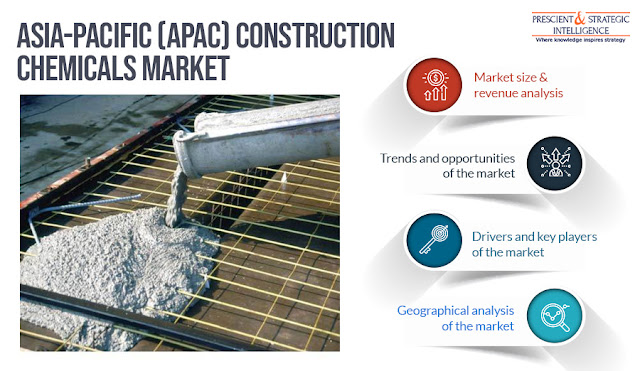
Due to the rampant growth of this industry, P&S Intelligence predicts the Asia-Pacific (APAC) construction chemicals market revenue to rise from $19,754.8 million in 2017 to $29,686.2 million by 2023, at a 7.1% CAGR between 2018 and 2023. This will essentially be due to the burgeoning population of the region, which is already the highest on earth. More people means a requirement for more houses, roads & highways, transportation facilities, schools, office complexes, hospitals, retail spaces, hotels, factories, and all other kinds of infrastructure imaginable.

In this regard, the government efforts to boost infra development in the region are propelling the demand for construction chemicals. For instance, the Indian government is developing 100 smart cities, eight ports and 14 special economic zones (SEZs), and 28 highway corridors and a total of 24,800 km of highways under the Bharatmala Project phase I. Moreover, the Eastern and Western Dedicated Fright Corridors and the Delhi–Mumbai Expressway, part of the larger Delhi–Mumbai Industrial Corridor, are being constructed.

As a result, the demand for concrete admixtures, sealants, adhesives, protective coatings, flooring chemicals, asphalt modifiers, and flame retardants is rising. Among these construction chemicals, concrete admixtures account for the highest consumption as they give strength to the structure and reduce the requirement for water. In a region that witnesses a lot of volcanic and tectonic activity, strong buildings are a must. For instance, North India and Japan are at an extremely high risk of severe earthquakes. Thus, with concrete being the key construction material, the demand for admixtures is surging in the region.

In the coming years though, India’s contribution to the APAC construction chemicals market will grow at the highest pace. As per the India Brand Equity Foundation (IBEF), between April 2000 and December 2020, the country’s construction sector received a total foreign direct investment (FDI) of almost $50 billion. Moreover, in the 2021 Union Budget, the government allocated $32.02 billion (INR 233,083 crore) for transportation infrastructure alone! Under this, over 600 railway stations have been identified for redevelopment, the entire broad-gauge network of Indian Railways is being electrified, and all routes are being double-tracked.

Thus, with governments pushing for infrastructure development in APAC, the demand for construction chemicals will boom in the coming years.

Why Are Indonesian Food and Beverage Firms Adopting Coding and Marking Systems?

The International Organization of Motor Vehicle Manufacturers (OICA) states that 139,886 commercial vehicles and 551,400 cars were manufactured in Indonesia in 2020. The automobile industry uses coding and marking systems for labeling metal, plastic, rubber, and other vehicle parts to provide quality assurance to customers. Additionally, effective labeling helps automakers track the components throughout the supply chain and keep a tab on counterfeiting. Thus, the surging automobile production, owing to the growing disposable income of people, will boost the adoption of such systems in the country.

Moreover, the increasing tobacco consumption will help the Indonesian coding and marking systems market grow at a healthy CAGR of 10.1% during 2018–2023. The market valued $27.4 million in 2017, from where it is expected to reach $48.7 million revenue by 2023. Tobacco companies use modernized and sophisticated coding solutions owing to their increasing focus on cleanliness. The adoption of advanced coding technologies assists tobacco companies in increasing productivity, enhancing readability, and printing high-resolution direct-to-the-box and automatic labels.

In recent years, the food and beverage industry has emerged as the leading user of these systems in Indonesia due to the implementation of stringent government regulations on traceability and product safety. Such regulations mandate the proper labeling of ingredients, nutrition facts, manufacturing and expiry dates, and manufacturer's details on the packaging of food items and drinks. This sector uses coding and marking solutions for labeling salty snacks, baked goods and cereals, beverage cans and bottles, dairy products, meat and poultry, eggs, beverages, fruits and vegetables, and pet food and animal feed.

According to P&S Intelligence, Jakarta dominated the Indonesian coding and marking systems market in the preceding years. This can be ascribed to the extensive demand for packaged food and beverages, construction items, and metal products owing to the vast population of the city. Coding and marking on these goods give quality assurance to the end users. Owing to these reasons, the city will also adopt this equipment at the highest rate in the upcoming years.

Thus, the flourishing automotive industry and burgeoning tobacco demand will augment the deployment of coding and marking systems in Indonesia.

Increasing Construction Activities Driving Indian Mold Release Agents Market Growth

Due to the surging construction activities and the increasing requirement for die casting for manufacturing automotive components, the Indian mold release agents market is exhibiting huge expansion. According to the forecast of the market research company, P&S Intelligence, the market revenue will rise from $114.6 million in 2018 to more than $153.9 million by 2024. Furthermore, the market is expected to progress at a CAGR of 5.2% from 2019 to 2024.

Due to the increasing urbanization rate and booming population, the Indian government is making huge investments in infrastructural development and construction projects. For example, the government is launching initiatives such as Housing for All and Smart City Mission. Additionally, as per the Union Budget 2019–2020, the Ministry of Road Transport and Highways received investments worth $15.48 billion (INR 1.12 trillion) from the government.

These funds will be used for constructing highways and roads in the country. The launch of such construction projects is driving the demand for mold release agents in India, as these materials are extensively used in concrete bricks. Apart from the surging construction industry, the expansion of the electrical and electronics industry, on account of the soaring disposable income of people, is also creating lucrative growth opportunities for the players operating in the Indian mold release agents market. 

As a result, the enactment of strict regulations regarding VOC emissions is fueling the demand for these mold release agents in the country. When application is taken into consideration, the Indian mold release agents market is classified into wood and fiber composites, polyurethane processing, concrete, uncured rubber, tire, rubber and other elastomers, plastic, and die-casting (ferrous and non-ferrous). Out of these, the polyurethane processing category dominated the market in 2018. This is attributed to the high requirement for polyurethane-based components in industries such as construction, footwear, and automotive. 

In the forthcoming years, the concrete category will expand massively in the Indian mold release agents market. This will be because of the surging usage of concrete blocks for constructing high-rise commercial and residential buildings in the country. Concrete construction applications are expected to generate huge demand for these agents in the country in the upcoming years. This is because mold release agents enable faster release of concrete materials from various molds and assist in maintaining the texture of the concrete bricks without causing any damage during the release of the brick from the mold. 

Hence, it is safe to say that the sales of mold release agents will explode in India in the coming years, mainly because of the surging construction and infrastructural development activities and the booming electrical and electronics industry in the country.

How Are Oil and Gas Reserves in North America Driving Low Strength Proppants Demand?

The U.S. Energy Information Administration (EIA) estimated that the proven reserves of crude oil in the U.S. increased to 367 million barrels and the natural gas reserves in the country stood at 494.9 trillion cubic feet, in 2019. Furthermore, the proven reserves of natural gas from shale in the country surged from around 68% of the total reserves in 2018 to about 71% in 2019. Whereas, the proven crude oil reserves in Canada stands at 171.0 billion barrels. 

The presence of extensive reserves of oil and gas in North America is resulting in increased exploration and production (E&P) activities in the region. As a result of the surging E&P activities, the low strength proppants market will advance at a CAGR of 9.8% during 2020–2030. According to P&S Intelligence, the market revenue will grow from $3,713.3 million in 2019 to $5,294.8 million by 2030. Both the U.S. and Canada have been using low strength proppants in conventional and non-conventional oil and gas wells to increase the flow of gas or oil during the hydraulic fracturing process.

Currently, low strength proppants manufacturers are expanding their facilities and engaging in geographical expansion to reach out to a greater number of customers. For instance, in June 2018, Alpine Silica announced to establish two new plants in Fay, Oklahoma and Van Horn, Texas. With the construction of these new projects, the company has secured around 51 million tons of reserves for the Oklahoma initiative. Similarly, in August 2018, Black Mountain Sand LLC announced its plan to expand its presence in Western Oklahoma's Mid-Continent.

Geographically, the North American region led the low strength proppants market in the preceding years, owing to the surging number of drilled wells and the increasing focus of oil and gas companies and governments on discovering new oil and gas reserves in the region. Moreover, the abundant availability of conventional and unconventional resources also fuels the production of low strength proppants in North America. Furthermore, the region is also expected to consume low strength proppants at the highest rate in the coming years, due to the increasing E&P activities.

Thus, the rising E&P activities in North America and the surging technological advancements in crude oil recovery processes will fuel the consumption of low strength proppants in the foreseeable future.

Booming Sales of Pharmaceuticals Driving Demand for Acetic Anhydride

The expansion of the pharmaceutical industry, especially in the developing nations of Asia-Pacific (APAC) such as India, Indonesia, Thailand, and China, owing to the surging investments being made in research and development (R&D) activities and the expansion of several large drug producing companies in the regional countries, is propelling the demand for acetic anhydride. Moreover, the healthcare sector is booming in this region, on account of the availability of affordable raw materials and labor and high government expenditure, which is also fueling the demand for acetic anhydride.

This is credited to the fact that the compound is extensively used as a synthesizer in acetaminophen, aspirin, and various other medicated drugs. Besides these factors, the mushrooming population of geriatric people is also positively impacting the worldwide sales of acetic anhydride. As per the World Population Ageing 2020 report published by the United Nations Department of Economic and Social Affairs (UNDESA), the population of people aged 65 years or above will rise from 727 million in 2020 to more than 1.5 billion by 2050. 

As geriatric people heavily consume aspirin and various other medicated drugs, their growing population is causing a sharp surge in the requirement for the compound. Moreover, older people need body pain killers and generic drugs, such as sulfa drugs, acetaminophen, cortisone, triacetin, and paracetamol, in which acetic anhydride is used heavily, for managing and treating various health conditions. Because of these factors, the revenue of the global acetic anhydride market is expected to surge from $3,476.1 million in 2019 to $4,950.4 million by 2030.

Globally, the acetic anhydride market will register huge expansion in the Asia-Pacific (APAC) region throughout the forecast period, as per the estimates of P&S Intelligence, a market research firm based in India. This is attributed to the growing use of the compound in the production of tobacco filters, textile fibers, food additives, and plastic products. Additionally, the expansion of these end-use industries, on account of the soaring investments being made by various organizations, is further boosting the demand for the compound in the region. 

Thus, the demand for acetic anhydride will explode in the forthcoming years, primarily because of the growing usage of the compound in pharmaceuticals, which are themselves experiencing a sharp surge in demand, on account of the increasing prevalence of chronic diseases and mushrooming population of geriatric people all over the world.

Why will Demand for Aerosol Surge in Northern India in Coming Years?

The mushrooming manufacturing and sales of commercial vehicles, passenger cars, two-wheelers, quadracycles, and three-wheelers are fueling the demand for aerosols in India. As per the Society of Indian Automobile Manufacturers (SIAM), the automotive industry in India manufactured 30,915,420 vehicles in 2018–10, which was 6.3% higher than the number of vehicles that were manufactured in the previous year (29,094,447). Similarly, as per the India Brand Equity Foundation (IBEF), the demand for automobiles will soar in the country in the coming years, owing to the increasing income of middle-class people and surging population of young individuals.

This will, in turn, propel the requirement for aerosols in the country. Apart from this factor, the expansion of the manufacturing sector, on account of the burgeoning requirement for electrical equipment, machinery, and consumer electronic devices, is also driving the expansion of the Indian aerosol market. Moreover, as per the Ministry of Commerce and Industry, the cosmetics and beauty products industry in India is predicted to exhibit rapid expansion from 2016 to 2021, because of the surging per capita income of people. 

Furthermore, the government is launching several initiatives for augmenting research and development (R&D) activities in the country’s manufacturing sector, which is also positively impacting the progress of the Indian aerosol market. As a result of these factors, the revenue of the market is predicted to rise from $526.28 million in 2019 to $891.13 million by 2030, while the market will demonstrate a CAGR of 6.0% between 2020 and 2030 (forecast period). 

The northern region dominated the Indian aerosol market during the last few years, and this trend will continue in the coming years as well, as per the estimates of the market research organization, P&S Intelligence. This will be because of the growing preference of customers for personal hygiene products, such as antiperspirants/deodorants, in the region. Additionally, the requirement for homecare and aerosol-based car care products is also rising sharply, which is also boosting the market advancement in the region. 

Hence, the demand for aerosol will shoot up in India in the coming years, primarily because of the surging manufacturing and sales of automobiles, growing requirement for homecare and personal care products, and surge in the manufacturing sector in the country.