Why will Demand for Adhesive Tapes Surge in Asia-Pacific in Coming Years?

The expansion of the automotive industry is driving the demand for adhesive tapes across the world. This is because tapes having adhesive characteristics are extensively used in the automotive industry, primarily in the form of protection tapes and double-sided tapes. Moreover, automobile manufacturers are increasingly preferring to use automotive tapes having adhesive properties over the conventionally used mechanical fasteners in order to reduce the weight of the automobiles. As mechanical fasteners such as screws and bolts increase the automobile’s weight, they are being rapidly replaced by lightweight adhesive tapes.

Besides the aforementioned factor, the development of recyclable adhesive tapes is also creating lucrative growth opportunities for the players operating in the adhesive tapes market. Many countries are restricting or banning the use of hazardous chemicals, which are generally needed for producing adhesive solutions. Additionally, various end users are preferring eco-friendly products such as water-activated tapes, which are biodegradable, over the traditional solutions, which is further boosting the popularity of adhesive tapes all over the world.

Owing to the above-mentioned factors, the revenue of the adhesive tapes market is predicted to rise from $54,333.4 million in 2017 to $74,954.6 million by 2023, while the market is expected to demonstrate a CAGR of 5.5% from 2018 to 2023 (forecast period). Depending on type, the market is divided into specialty and commodity tapes. Between these, the specialty tapes category is predicted to record faster growth in the coming years. 

The Japanese Adhesive Tape Manufacturers Association (JATMA) and the China Adhesives and Tape Industry Association (CATIA) are the two major organizations that are developing adhesive solutions in APAC. Apart from these factors, the existence of numerous major manufacturing companies such as LINTEC Corporation and Nitto Denko Corporation and the increasing efforts being made by them for commercializing adhesive tapes are also propelling the growth of the market in the region.

Hence, it can be said without any doubt that the demand for adhesive tapes will surge sharply in the forthcoming years, mainly because of their growing requirement in the automotive industry, which is itself exhibiting huge expansion across the globe.
How Is Growing Aerospace Sector Driving Ceramic Matrix Composites Market?

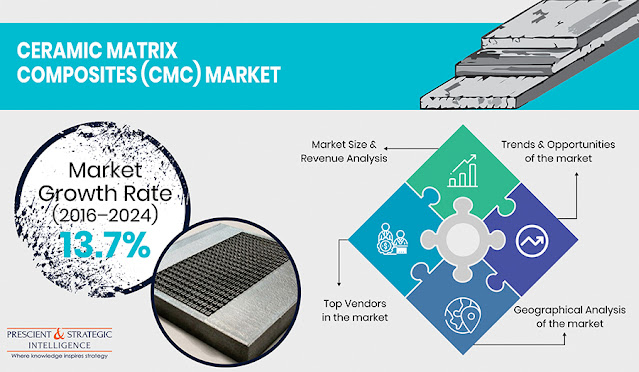
From $1,891.3 million in 2015, the ceramic matrix composites market size is projected to witness a 13.7% CAGR during 2016–2024 (forecast period), to reach $6,006.1 million by 2024. The key factors driving product sales include the rising usage of lightweight composites in aircraft manufacturing and surging demand for CMCs in the defense sector. These materials consist of a ceramic matrix with ceramic fibers embedded in it. Their biggest advantages are high-temperature functionality, resistance to wear and tear, high stiffness, and corrosion resistance.

Silicon carbide (SiC), oxide, carbon, and others are the categories when the market is segmented on the basis of product. Among these, during the historical period (2014–2015), the SiC category dominated the ceramic matrix composites market on account of the rising demand for SiC-based CMCs in the defense, aerospace, and electronics industries. The hardness, high strength, corrosion resistance, high thermal stability, and low mass density of SiC make it a preferred choice for CMCs in these sectors.

Lightweight vehicles are trending in the ceramic matrix composites market because of the global outcry for mitigating pollution and climate change. According to the U.S. Department of Energy, a reduction in the weight of a vehicle by 10% can raise its fuel efficiency by 8%. Moreover, the replacement of steel and iron automobile components with those made of aluminum alloys, polymer composites, magnesium alloys, and carbon fiber can lead to a massive 50% reduction in the vehicle weight and, in turn, in considerable fuel savings.

Presently, North America dominates the ceramic matrix composites market because it is the largest aerospace and defense producer in the world. Moreover, the U.S. is also the largest buyer of defense equipment and one of the largest buyers of commercial aircraft for public and personal usage. As of May 2019, the largest airlines in the world by fleet size were American Airlines, United Airlines, Delta Air Lines, FedEx Express, and Southwest Airlines, all based in the U.S. Similarly, with over 13,00 aircraft of all types, the U.S. Air Force (USAF) is the largest on earth.

Hence, with the burgeoning aerospace, defense, and automotive production, the market will reach new heights.

Surging Aircraft Sales Augmenting Demand for Thermal Spray Materials

The mushrooming popularity of the aerial mode of transportation is fueling the expansion of the aerospace industry, which is, in turn, driving the worldwide sales of thermal spray materials. Moreover, the increasing defense expenditure of several countries, such as India, the U.S., Japan, and China is also propelling the growth of the aerospace industry. For example, as per various estimates, China will spend more than $1.1 trillion in aircrafts over the next 20 years. 

As thermal sprays are extensively used in coatings, which are applied on turbo-machinery, such as high-pressure turbine seals, rotor-path linings, bearings, compressor seals, airframe, engine components, and oil seals, in order to improve fuel efficiency and fluid dynamics, reduce maintenance expenses, and prevent wear and tear, the soaring sales of both defense and commercial aircrafts are driving their demand across the world. Apart from the booming aerospace industry, the rising urbanization rate, especially in the Eastern European and Asia-Pacific (APAC) regions, is also fueling the requirement for industrial machinery in construction, automobiles, and consumer product industries.

As these equipment need thermal spray materials for preventing corrosion, erosion, wear, and various other damages, their rising usage is predicted to fuel the growth of the global thermal spray materials market in the coming years. According to the forecast of the market research company, P&S Intelligence, the revenue of the market will grow from $1,860.8 million in 2018 to $2,869.2 million by 2024. Furthermore, the market is expected to demonstrate a CAGR of 7.4% from 2019 to 2024.

Wire/rod and powder are the two types of thermal spray materials used all over the world. Between these, the demand for wire/road materials was found to be higher during the last few years. This was because of the fact that by utilizing wire/rod materials, only the molten droplets reach the substrate, which minimizes wastages. Moreover, the flame exiting the nozzle of the spraying machine is concentric, when wire/rod materials are used, which leads to uniform heating for the proper spraying of the material.

Industrial gas turbines, electronics, energy and power, food processing, industrial manufacturing, mining, rubber producing, textile producing, automotive, oil and gas, aerospace, and medical devices are the major end-use industries of thermal spray materials. Amongst these, the requirement for these materials was the highest in the aerospace industry during the past years. This was because of the fact that thermal spray materials were extensively used for coating different aerospace components for both military and commercial aircrafts. 

Geographically, the demand for thermal spray materials was found to be the highest in North America during the last few years. This was because of the existence of a thriving automotive industry, owing to the soaring sales and manufacturing of automobiles and automotive components in the region. In addition, the region is home to some of the leading military and civil aircraft manufacturing companies, such as Lockheed Martin Corporation, Bombardier Inc., and The Boeing Company, which is also boosting the demand for thermal spray materials.

Hence, the demand for thermal spray materials will shoot up in the years to come, mainly because of their growing usage in automotive and aerospace industries across the world. 

Why Is Growing Hygiene Awareness Driving Demand for Spunbond Nonwovens?

A lot of diseases spread via bodily fluids and excretions, including some really nasty ones, such as cholera, bacillary dysentery, typhoid, hepatitis A and E, E. coli, amoebiasis, toxoplasmosis, and tapeworms. This is why the focus on personal hygiene is rising around the world, which is driving the sale of diapers, feminine hygiene pads, and toddler training pants. Moreover, the awareness campaigns being run by international agencies, such as the World Health Organization (WHO), and national governments are propelling the sale of such products.

As a result, according to P&S Intelligence, the spunbond nonwovens market value, which was $11,040.1 million in 2017, is set to witness an 8.1% CAGR between 2018 and 2023, to reach $17,651.9 million by 2023. This is because such materials are widely used in the production of hygiene pads, diapers, and wipes. Therefore, with the focus on hygiene and general cleanliness having grown manifold during the ongoing pandemic, spunbond nonwoven sales have risen as well. The greatest impact of the sale of such materials in this regard has been perhaps due to the hoarding madness surrounding face masks, which have been widely accepted as being essential for stopping infection transmission.

All these kinds of products can be made disposable and non-disposable, of which spunbond nonwovens have been used in higher volumes for disposable products. This is because of the surging awareness regarding the transmission of pathogens from one person to another. This is a grave problem even in healthcare settings, with the Centers for Disease Control and Prevention (CDC) saying that in the U.S., “On any given day, about one in 31 hospital patients has at least one healthcare-associated infection”. Therefore, healthcare settings are subjected to rather stringent infection control guidelines, which include the mandatory usage of disposable surgical gowns and face masks.

Asia-Pacific was the largest spunbond nonwovens market in the past, and it will continue being so in the years to come. The region is already the largest producer of PP, polyester, polyethylene, and polyurethane, which are the key raw materials for spunbond nonwovens. This leads to cost-effectiveness for the producers of these materials, which further makes the end products cheap for the masses. Additionally, the huge customer base in APAC leads to the high sales of the end products.

Hence, with the rising awareness on personal hygiene, the demand for spunbond nonwovens is booming.

Why will Generator Set Sales Shoot Up in Tamil Nadu in Coming Years?

With the expansion of the manufacturing and construction industries, on account of the implementation of various government initiatives such as Make in India and the launch of outreach programs for micro, small, and medium enterprises (MSMEs), the demand for gensets is surging sharply in India. Moreover, the government is making huge investments in the development of industrial corridors and providing financial incentives, which are also contributing heavily toward the surge in the manufacturing industry.

This is, in turn, pushing up the requirement for gensets, owing to their ability to meet the captive, uninterrupted, and centralized power supply needs of the industry. Additionally, with the establishment of new facilities, the demand for gensets is predicted to rise even more, as they will be required for supply continuous power in these facilities. Just like the manufacturing industry, the construction industry in the country is also booming, owing to the soaring investments being made by various public and private players, development of urban housing infrastructure, and construction of commercial installations such as logistics centers and telecom towers.

As work is conducted 24*7 at construction sites, gensets are used extensively at these sites. Because of this reason, the increasing construction activities are predicted to propel the Indian generator set market at a CAGR of 6.8% between 2020 and 2030 (forecast period). Furthermore, the value of the market will surge from $554.5 million in 2019 to $855.1 million by 2030, as per the estimates of the market research company, P&S Intelligence. 

In India, gensets are widely used in industrial, residential, and commercial sectors. Out of these, the use of gensets was found to be the highest in the commercial sector in 2019 and this trend will continue in the forthcoming years as well. This is credited to the large-scale deployment of gensets in hospitals, malls, restaurants, retail outlets, telecom towers, and various other commercial establishments. Offices, hotels, hospitals, telecom towers, and retail establishments are the largest commercial users of gensets in the country. 

Amongst these, the demand for gensets was observed to be the highest in telecom towers in 2019 and the situation will not change in the coming years as well. This is attributed to the fact that requirement for backup power is significantly high in the telecom sector. In India, the sales of gensets are expected to rise sharply in Tamil Nadu in the forthcoming years. This will be because of the existence of several genset manufacturing companies in the state. Additionally, many manufacturers are focusing on capacity expansions, which is further boosting the growth of the Indian gensets market in the state.

Thus, the sales of gensets will soar rapidly in India in the coming years, mainly because of the expansion of the manufacturing and construction industries, on account of the enactment of supportive government policies, and rising requirement for backup power in various commercial facilities and residential houses in the country. 

India Diesel Generator Set Market To Generate $2,365.2 Million Revenue by 2030

Factors such as the flourishing manufacturing sector in India and burgeoning demand for power for commercial applications will help the Indian diesel genset market to advance at 12.5% CAGR during the forecast period (2020–2030). The market was valued at $1,105.7 million in 2019 and it is expected to generate $2,365.2 million revenue by 2030. Diesel gensets are required in almost every manufacturing and commercial facility to maintain continuous power supply, on account of the frequent power cuts in the country.

In recent years, the booming manufacturing sector in India has become a primary catalyst for the market growth. The boom in the manufacturing sector can be credited to the launch of government initiatives such a Make in India and the introduction of numerous outreach programs for micro, small, and medium enterprises (MSMEs). Additionally, the hefty investments being made by the government in industrial corridors are also facilitating the growth of the manufacturing sector in the country. Manufacturing facilities are deploying diesel gensets to meet their uninterrupted, centralized, and captive power supply needs.

Furthermore, the burgeoning power demand from the commercial sector will also catalyze the Indian diesel genset market growth in the foreseeable future. The surging number of urban housing projects and increasing construction of telecom towers and logistics centers are creating a high demand for diesel gensets in the country. Moreover, the rapid construction and localization of data centers, owing to the implementation of data protection laws and favorable government policies regarding the development of data centers, will also drive the demand for diesel generators in India in the upcoming years.

The power rating segment of the Indian diesel genset market is categorized into above 750 kVA, 376 kVA–750 kVA, 76 kVA–375 kVA, and 5 kVA–75 kVA. Under this segment, the 5 kVA–75 kVA category accounted for the largest market share in 2019, due to the large-scale adoption of diesel gensets within the power range of 5 kVA–75 kVA in residential societies, small-scale industries, and restaurants to meet their extensive demand for auxiliary power. 

According to P&S Intelligence, the Indian diesel genset market was collectively dominated by Tamil Nadu, Uttar Pradesh, Maharashtra, Karnataka, and Andhra Pradesh in 2019. This can be attributed to the mounting investments being made in the telecom sector and escalating focus on the development of commercial infrastructure in these Indian states. Leading telecommunication companies, such as Bharti Airtel and Reliance Jio Infocomm Ltd. are actively focusing on the development of a strong telecom infrastructure in these states. Additionally, the soaring number of residential facilities will also supplement the market growth in these states in the forecast years. 

Therefore, the expansion of the manufacturing and commercial sectors and rising number of housing infrastructure projects will augment the market growth in the coming years. 

Why Is Automotive Adhesive and Sealant Demand Surging in Germany?

The International Organization of Motor Vehicle Manufacturers (OICA) estimated that a total of 3,742,454 vehicles were manufactured in Germany in 2020. Further, the German Association of the Automotive Industry stated that the production volume of passenger cars in Germany increased from 123,504 units in August 2021 to 208,700 units in September 2021. Thus, the increasing vehicle production in the country, owing to the presence of automobile giants, will propel the adoption of automotive adhesives and sealants in the country, as they help in improving reliability, performance, driving comfort, and safety of vehicles. 

Moreover, the increasing adoption of electric vehicles (EVs), owing to the mounting government support toward environment-friendly mobility solutions to mitigate air pollution, is also expected to fuel the German automotive adhesives and sealants market at a CAGR of 4.5% during 2018–2023. According to P&S Intelligence, the market revenue will rise from $891.8 million in 2017 to $1,156.8 million by 2023. The Government of Germany offers a tax exemption of 10 years for EVs (fully electric or fuel-cell vehicles) registered from 1 January 2016 until 31 December 2025.

In recent years, automobile companies in Germany have been consuming a significant volume of epoxy-based adhesives and sealants to produce several automobile components, due to their strong bonding capability, ease of application, and higher moisture resistance. Besides, the high durability, exceptional flexibility, and excellent impact resistance properties exhibited by such products make them ideal for the production of headlights and signal lights and bonding of bumpers in vehicles. Furthermore, automobile original equipment manufacturers (OEMs) of Germany are also using acrylics, hot melts, rubber, silicones, polyvinylchloride (PVC), and polyurethanes in several vehicle components.

This transformation in the German automotive adhesives and sealants market is being brought about by H.B. Fuller Company, Henkel AG & Co. KGaA, tesa SE, Sika AG, DowDuPont Inc., and H.B. Fuller Company. Conventional and eco-friendly adhesives produced by these companies are used in the assembly, body in white (BIW), paint shop, and under-the-hood (UTH) and power train applications. In the preceding years, automakers utilized the highest volume of adhesives and sealants in assembly applications. 

Thus, the surging vehicle production and sales and the burgeoning demand for EVs are expected to accelerate the consumption of automotive adhesives and sealants in Germany.

Asia-Pacific Plasticizers Market To Prosper in Coming Years

The global plasticizers market reached a value of $13,967.9 million in 2018 and it is expected to generate $16,700.6 million revenue by 2024. According to the estimates of P&S Intelligence, a market research company based in India, the market will demonstrate a CAGR of 3.5% from 2019 to 2024 (forecast period). The market is being driven by the booming construction industry and the soaring requirement for polyvinyl chloride (PVC) in the electronics and electrical industry. 

Plasticizers are required for building various tools and materials, such as roof and wall insulation, building interiors, and pipes and tubes, which are needed in large quantities in the construction industry. As most of these tools are produced from PVC, the increasing construction activities in several countries are propelling its demand. Furthermore, the construction industry has exhibited huge expansion during the last few years, primarily because of the increasing urbanization rate and mushrooming population.

Depending on product, the plasticizers market is divided into phthalates and non-phthalates categories. Of these, the phthalate category held the larger share in the market in 2018. This was because of the extensive usage of these materials in the production of products, such as plastics used in the healthcare industry, coatings, emulsifying agents, and anti-viscosity agents. The non-phthalates category is also predicted to demonstrate rapid advancement in the coming years, due to their less toxic nature. 

The market is also categorized, based on end-use, into wires and cables, flooring, roofing, and cladding, films and sheets, automotive parts, medical equipment, and toys and child care products. Out of these, the wires and cables category dominated the market in 2018, and it is predicted to demonstrate a CAGR of 3.8% throughout the forecast period. This is attributed to the extensive usage of wires and cables, that require flexible PVC for insulation and protection. 

Additionally, the expansion of the healthcare, construction, packaging, and several other industries is also predicted to generate a huge requirement for plasticizers in the forthcoming years. Geographically, the Asia-Pacific (APAC) region is expected to be the fastest growing region in the plasticizers market during the forecast period. This is credited to the soaring demand for plasticizers in the automotive, manufacturing, construction, electrical and electronics, and chemicals industries in the region. In these industries, plasticizers are required for imparting flexibility to or smoothening various end products. 

Hence, the market is set to surge sharply in the coming years, mainly because of the increasing construction and infrastructure development activities all over the world. 

Surging Automobile Sales Driving Indian Industrial Aerosol Market

The Indian industrial aerosol market value stood at $70.95 million in 2019, and it is expected to surge to $115.85 million by 2030. Furthermore, the market will advance at a CAGR of 5.6% from 2020 to 2030 (forecast period), as per the market research firm, P&S Intelligence. The major factors propelling the market are the surging requirement for aerosols in automobile manufacturing plants and the automobile aftermarket, booming manufacturing industry, and increasing implementation of government initiatives for augmenting research and development (R&D) activities in the country’s manufacturing industry.

With the surging manufacturing and sales of commercial vehicles, passenger cars, two-wheelers, quadracycles, and three-wheelers, the requirement for industrial aerosols is rising sharply. As per the Society of Indian Automobile Manufacturers (SIAM), 30,915,420 vehicles were manufactured in India in 2018–19, which registered an increment of 6.3% from the number of vehicles manufactured during the previous year (29,094,447). Likewise, as per the India Brand Equity Foundation (IBEF), the demand for automobiles will surge in the country in the coming years, because of the soaring population of young people and surging income of the middle-class populace in the country.

The Indian industrial aerosol market is divided, depending on application, into cleaning, spray paints, and maintenance. Out of these, the spray paints category held the largest share in the market in the years gone by, and this trend is predicted to continue in the coming years as well. This is credited to the flourishing automotive aftermarket, because of the soaring purchasing power of people, in the country. The market is currently fragmented in nature, with the existence of players, such as Aerosol Specialities (India), Pidilite Industries Limited, S. S. Aerosols Pvt. Ltd., Zenith Spray And Aerosols Private Limited, Aerol Formulations Private Limited, and PRIME AEROSOLS.

In recent years, the players operating in the Indian industrial aerosol market have focused on product launches in order to gain an edge over their rivals. For example, 3M Company launched the 3M Scotchkote Polytech Exp RG700, which is an anti-heat solution for the Indian Railways, in May 2020. This is basically a solar-reflective layer that mitigates the heat inside a building or an enclosure, and it can be easily applied on various metallic and non-metallic substrates. Similarly, CRC Industries Inc. launched OZZYJUICE SW-X1, which is a new degreasing solution, in November 2019. 

Hence, the market will grow substantially in the coming years, primarily because of the growing requirement for industrial aerosols in automobile manufacturing plants and booming manufacturing sector in the country.


How Is Expanding Chemical Sector Facilitating Chlorobenzene Sales?

Pharmaceutical companies around the world are increasingly using chlorobenzene, especially trichlorobenzene, to synthesize intermediates of a wide range of medicines, such as antibiotics and vitamin supplements. In recent years, these companies in developing countries have focused on the local production of essential generic drugs to reduce cost burden on customers. Since 2006, the United Nations Industrial Development Organization (UNIDO) has offered advisory services and technical cooperation to facilitate local pharmaceutical production (LPP) in developing countries with a large number of private- and public-sector partners. Thus, the rising production of generic drugs will create a huge requirement for chlorobenzene worldwide. 

Moreover, the expanding chemical industry will also contribute to the chlorobenzene market growth during the forecast period (2021–2030). According to P&S Intelligence, the market generated $2.3 billion revenue in 2020. Chemical companies are using chlorobenzene as a solvent in the synthesis of insecticide and pesticide formulations, drugs, di-phenyl oxide, organic chemicals, nitrobenzene, and di-isocyanate. Additionally, the compound is also used in degreasing automobile parts. Thus, the surging automobile sales and the increasing focus on prolonging vehicle age will also act as key growth drivers of the market.

The application segment of the chlorobenzene market is classified into polymer, polysulfone, solvent, nitrochlorobenzene, and others. Under this segment, the nitrochlorobenzene category accounted for the largest market share in 2020. This is due to the surging use of 4-nitrochlorobenzene as an intermediary in the production of common industrial products, such as polymers, sulfur dyes or azo, antioxidants in rubber production, and agrochemicals. This compound is also used in the production of oil additives and antimalarial drugs such as Dapsone.

Globally, the Asia-Pacific chlorobenzene market generated the highest revenue during the historical period (2015–2020), and it is expected to maintain its lead throughout the forecast period as well. This can be ascribed to the surging use of the compound in the production of herbicides and polyphenylene sulfide resins. As China is home to a large number of manufacturing plants, it has emerged as the leading producer and consumer of chlorobenzene in the world.

Therefore, the soaring production of generic drugs and the flourishing chemical industry are expected to propel the demand for chlorobenzene in the forthcoming years.

Why Are Oil and Gas Companies Deploying Artificial Lifts in Mature Oilfields?

Artificial lifts are deployed in oil wells to enhance the pressure within the reservoirs, to bring the oil to the surface. These machines are used to recover oil from reservoirs that are witnessing a reduced pressure due to the constant extraction. Artificial lifts can be used in offshore as well as onshore mature oil fields to increase the bottom-hole pressure of the reservoirs. These lifts can be gas-assisted or pump-assisted. Currently, oil companies are preferring pump-assisted artificial lifts over gas-assisted variants as the former can increase the bottom-hole pressure of the tube string.

Thus, the rising number of mature oil fields is expected to drive the artificial lift market at a CAGR of 5.3% during the forecast period. Additionally, the surging availability of recoverable shale gas reserves in different parts of the world will help the market revenue grow from $8,010.8 million in 2017 to $10,883.1 million by 2023. For instance, the U.S. Energy Information Administration (EIA) reveals that shale gas reserves are found in nearly 30 states of the U.S.

The type segment of the artificial lift market is classified into rod lift, gas lift, progressive cavity pump (PCP), electrical submersible pump (ESP), and others, such as hydraulic jet pump, plunger lift, and other small lifts. In 2017, the ESP category generated the highest revenue due to the ability of tightly contained units of ESPs to prevent leaks and short circuits. These artificial lift systems use direct pressure through the pipe to extract the liquid, owing to which they are more effective than the suction method as they can extract oil from greater depths of the earth.

Globally, the North American artificial lift market generated the highest revenue during the historical period (2013–2017), and it is expected to continue this trend throughout the forecast period. The dominance of North America can be primarily ascribed to the presence of established players in the U.S. and Canada. Additionally, the increasing number of mature oil fields in the U.S. and rising preference for unconventional oil and gas reserves over traditional fields will support the market growth in the region.

Therefore, the increasing number of mature oil fields and rising availability of recoverable shale gas reserves will augment the global demand for artificial lifts.

How Is Pharmaceutical Industry Supporting Microfiltration Membrane Market Growth?

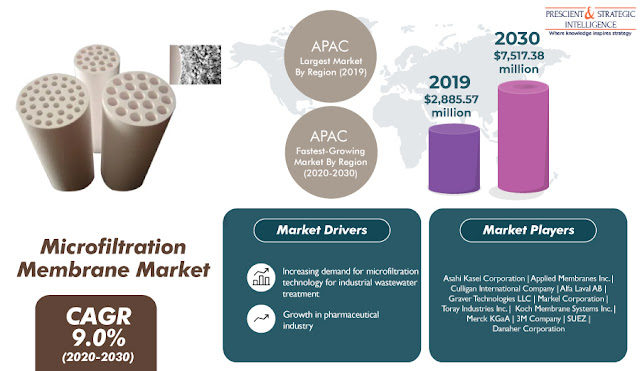
The microfiltration membrane market is expected to exhibit a CAGR of 9.0% during the forecast period (2020–2030), owing to the surging usage of filtration technology in the food and beverage industry, flourishing pharmaceutical industry, and burgeoning demand for microfiltration technology for the treatment of industrial wastewater. According to P&S Intelligence, the market was valued at $2,885.57 million in 2019 and it will generate $7,517.38 million revenue by 2030. Unlike conventional separation technologies, microfiltration technologies can efficiently treat solutions containing excessive dissolved organic compounds. 

One of the primary growth drivers of the market is the flourishing pharmaceutical industry. Pharmaceutical companies use an extensive volume of microfiltration membranes, such as polyethersulfone (PES), polypropylene (PP), and polyvinylidene fluoride (PVDF), for the filtration of proteins and preservatives, due to their high-flow rate, low-protein binding ability, and exceptional retention capacity. Additionally, the increasing investments being made in research and development (R&D) projects in the domain of biotechnology and medicine will also facilitate the market growth.

The application segment of the microfiltration membrane market is classified into biotechnology, dairy, food and beverage, industrial wastewater treatment, oil and gas, pharmaceutical, semiconductor and electronic, and others, such as metal and catalyst recovery and solvent recovery. Among these, the industrial wastewater treatment category generated the highest revenue in 2019, due to the increasing scarcity of usable water, rising concerns over the limited availability of water, and booming demand for safe water for commercial, industrial, and residential applications.

Geographically, the Asia-Pacific (APAC) region held the largest share in the microfiltration membrane market in 2019, owing to the escalating need for wastewater treatment, toughening regulatory standards on water treatment, and increasing desalination activities to meet the water shortage in emerging economies, such as the Philippines, India, Thailand, and China. Moreover, the soaring number of manufacturing plants and research centers of pharmaceutical and biotechnology companies will also propel the demand for microfiltration membranes in the region. 

Therefore, the expanding pharmaceutical industry and burgeoning demand for uncontaminated food products and beverages will drive the demand for microfiltration membranes worldwide.