Why Will North America Rule the 5G Satellite Communication Industry?

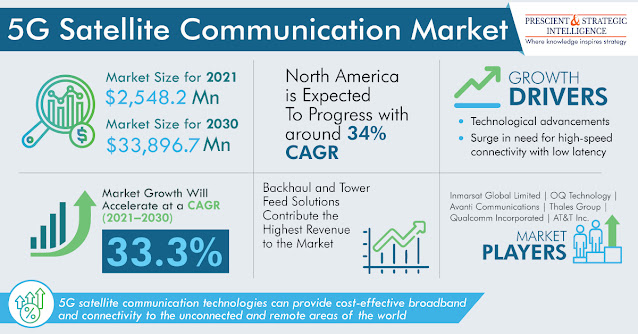
The 5G satellite communication market is projected to experience a strong CAGR of 33.3% by the end of this decade to reach , USD 33,896.7 million by 2030.

5G Satellite Communication Industry Report 2030

The growth of the industry is mainly attributed to the rising advancements in technology and the increasing demand for high speed with low-latency connectivity. 

This 5G network, by upgradation of passive assets such as fiber networks and data centers are helping governments and policymakers to transform cities into smart cities, enabling residents to benefit from an advanced digital economy that relies on data. 

Geo-political conflicts and wars made the non-terrestrial technology crucial for defense forces, with the advanced 5G satellite communication systems further improving defense decision-making. In addition, IoT enabled satellite systems and integration of AI & ML in near future will expand the applications of new technologies in defense sector.

Backhaul and tower feed solutions hold the largest revenue share, of over 80%, in 2021. The industry is benefiting from their ability to multicast high-design content and videos across wide coverage areas. 

Whereas, the hybrid multiplay category is witnessing the fastest growth, offering high-speed connectivity, multicast the same video distribution and efficient BB connectivity for aggregated IoT data.

The GEO category is the fastest growing category with a 34% CAGR in the years to come, because of its versatile applications. While, the LEO category held the largest revenue share in 2021 and this trend will continue in the near future due to its cost-effective launching for small satellites in this orbit.

This 5G satellite communication technologies are sought for defense, government, commercial industries and individuals who want affordable solutions including access to the cost-effective broadband and connectivity to remote regions lacking terrestrial network coverage. These factors are driving the growth of the market.

North America 5G satellite communication market held the largest revenue share of  30% in 2021, and will reach USD 12 billion by 2030 with the highest growth rate in the years to come This is mainly due to the major contribution of the U.S. along with the presence of key players in the region.

APAC is expected to have the second-highest growth rate over the forecast period due to high demand for connectivity in emerging economies with the rise in R&D investments along with technological advancements and government initiatives in the region. 

Moreover, China contributes significantly to the growth of the region due to the growing demand from large population and with continuous focus on improving 5G services due to its improving economy and government support.

It is because of the tech advancements happening all over the all over the world, the demand for  5G satellite communication is on the rise, and will continue to grow in the future as well.

How Tokenization Works?

Tokenization is the procedure of changing sensitive info with unique identification signs that recall all the essential data regarding the info without compromising its safety. Tokenization, which seeks to minimize the quantity of sensitive info a business requirement to keep on hand, has become a common method for small and midsize industries to bolster the safety of credit card and e-commerce dealings while diminishing the price and difficulty of compliance with industry standards and government guidelines.

The tokenization market is witnessing growth and is projected to reach USD 12,684.2 million 

by 2030.

Tokenization Industry Development and Forecast Report 2030

Benefits of Tokenization

Tokenization creates it more complex for hackers to get accessibility to cardholder info, as 

compared with older arrangements in which credit card numbers were stowed in databases and swapped freely over networks.

The Key Advantages of Tokenization Include the Following:

It is well-matched with legacy systems in comparison to encryption.

It is a reduced amount of resource-intensive procedure in comparison to encryption.

It decreases the fallout dangers in a data breach.

It brands the payment sector more suitable by driving new technologies such as 

mobile wallets, one-click transactions, and cryptocurrency. This, ultimately, improves purchaser trust because it advances both the safety and suitability of a merchant's service.

It decreases the steps involved in obeying PCI DSS guidelines for merchants.

How Tokenization Works

Tokenization replaces sensitive data with equal no sensitive data. The no-sensitive, replacement data is called a token.

Tokens Can be Formed in The Following Ways:

Utilizing a statistically reversible cryptographic function with a key;

Utilizing a no-reversible function, like a hash function.

Utilizing an index function or arbitrarily generated number.

Accordingly, the token turns out to be the exposed data, and the delicate information that the token stands for is kept securely in a central server known as a token vault. The token vault is the only place where the unique information can be charted back to its corresponding token.

Here Is One Real-World Instance Of How Tokenization With a Token Vault Works.

• A purchaser delivers their transaction details at a point-of-sale (POS) system or online checkout form.

• The details, or info, are relieved with an arbitrarily produced token, which is generated in most cases by the merchant's payment gateway.

• The tokenized data is then encrypted and directed to a payment mainframe. The original delicate payment data is kept in a token vault in the merchant's payment gateway. This is the only location where the token can be recorded to the data it represents.

• The tokenized data is encrypted again by the payment processor before being sent for concluding authentication.

• Alternatively, some tokenization is vault less. In place of storing delicate data in a safe database, faultless tokens are kept utilizing an algorithm. If the token is rescindable, then the original sensitive data is usually not stored in a vault.

Hence, the increasing financial scams and the growing requirement to secure payment gateways. fulling security standards to avert a data breach, while guaranteeing the customer experience is also projected to fuel the development of the market.

How Technology Is Impacting the Wide World of Sports

In a state where we are progressively connected to the digital world — through, tablets, smartphones, smartwatches, notebooks, and so on—it's not tough to observe the growing use of technology in sports.

Presently, it plays an essential role, supporting countless athletes, from different sports sensory systems, to advance their performance while training and tournaments.

Monitoring the advancement of matches has also become convenient and more effective, thanks to smart devices.

The sports technology market is experiencing growth and is projected to reach USD 53,020 million by 2030.

What is technology in sports?

The sports setting has always been quite intricate. The search for new plans and methods to advance the performance of sportspersons led to the acceptance of approaches, objects, and accessories in the routines of different modalities.

All this is done to offer more ease for the sportsman, while it is likely to extract a brilliant performance.

Furthermore, the technologies applied to sports aid to get fundamental information for the reproduction of sports statistics. Therefore, the coach's decision-making for his player is enhanced.

What are The Benefits of Technology in Sport?

As we all know, technology has become a great helper of sport, offering several advantages to the environment.

Every innovation that comes in the industry, inspires sportspersons to surpass their limits, furthermore to help judges when monitoring matches.

Therefore, when the human eye fails to see certain data, artificial intelligence covers this gap, contributing to a reasonable result.

In football, for instance, umpires utilize electronic points to surge the effectiveness of their actions. This same technology is also utilized in tennis and volleyball courts in order to surge the precision of results.

What is The Influence of Technology on Sports?

Sports, like football, volleyball, fencing, swimming, athletics, and others, already advantage from the utilization of technological novelties.

The development of competitive physical activities, the outcome of real-time communication between coaches and athletes, is extraordinary. Furthermore, the growth of special materials, in order to fuel maximum performance, stays constant.

They are smart costumes, devices with devices for information gathering, and also performance analysis. The main technologies accountable for these advances are:

Nanotechnology: includes the making of tissues with nanoparticles, which stiffen in case of impact, in order to shield the sportsperson from the wound. It is a technology still under examination, but it shows promising data;

Biomechanics: widespread in swimming, screens the jumps and strokes of athletes, furthermore to stalking their heart rate. It plays an important role in the growth of fast skin, a special costume that decreases the body's friction with water in races;

Hawkeye: Utilized on tennis courts, this technology signifies a system of screening cameras, skilled in classifying the ball from any angle after its release.

ICT (Communication and Information Technology): Artificial intelligence is utilized in different games to support the coach to recognize the fortes and weaknesses of his athletes to advance them more efficiently.

Milking Automation Have Really Made the Life of Farmers Easily

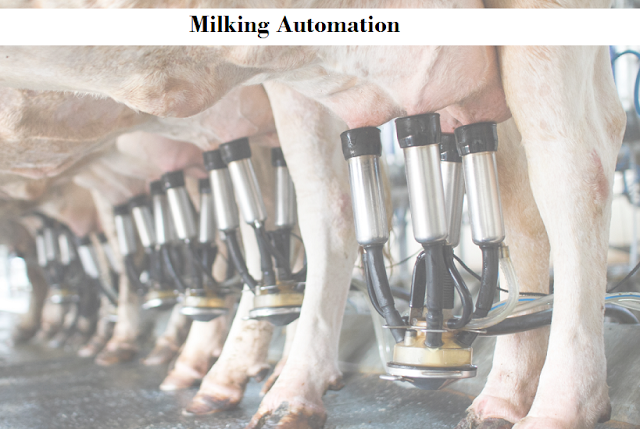
Milking Automation is the procedure of milking dairy animals, without the requirement for humans. Computers and advanced machinery are used to keep track of the cattle health. The milking process is dedicated to obtaining milk from an animal. Farmers use automatic cattle control; the milking machine has completely automated the process of milk extraction.

Some manufacturers of automated milking systems recommend the use of a selection gate to let just those cattle who have been milked to the outer pastures if the cattle are to be grazed too. An automated milking system has a capacity of 50–70 cows per milking unit.

Automated milking systems generally attain milking frequencies amid 2 and 3 times daily, so a single milking unit handling 60 miking animals and milking each thrice daily can milk approximately 7.5 cows per hour.

Since the early robotic milking devices are commercially accessible and have been a rather fruitful in accepting the voluntary milking method. 


What are the Advantages of Robotic Milking Systems

There is No Need for Labor

The farmer is unfettered from the milking process and its supplementing strict schedule, and his time can spend in overseeing the cattle, feeding them, and taking care of them.

Rising Frequency of Milking

Milking of animals can be done up to 3 times a day, though most individuals only milk 2.5 times daily. Due to the fact that less milk is averagely stored, this result in decreased tension and the improved comfort for the animal. Milk output per animal surges with regular milking, though much of this surge is made up of water more than solids.

Milking can be Done More Consistently

The method of milking every animal, whether it is a cow or buffalo is unaffected by the fact that the animals are milked by numerous people. For the reason that the 4 milking cups are removed distinctly, an empty quarter doesn’t remain connected while the other 3 are completing, decreasing the risk of any sort of harm.

Herd Management can be Made Easy

The usage of computer offers more options for data collection. Such info helps farmers to improve herd management by analyzing the patterns in the herd, for example the reaction of milk output to feedstuff alterations. Histories of the animals can be checked, and alarms can help to notify the farmer if any odd variations could point to an injury or a disease. 

The collection of info adds value to the automatic milking system, but precise understanding and use of that data are profoundly reliant on the ability of the user or the precision of computer algorithms used in the creation of attendance reports.  

Coming to a Concrete Conclusion

The increasing herd size in the farms all over the world has a lot to do with the growing demand for milking automation systems. This trend will continue in the future and the value will reach USD 1,796 million by the end of this decade.

Machine Learning Operations Market is Driven by Increasing ML Platforms Popularity

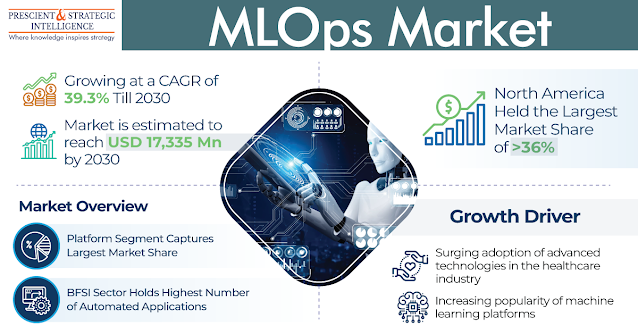
The machine learning operations market was USD 1,226 million in 2022, which will increase to USD 17,335 million, advancing at a 39.3% compound annual growth rate, by 2030.

With the rising trend of imbibing entities with developed technology like artificial intelligence, the need for ML models and the operationalization of ML has been deploying swiftly to effectively process automation. 

Machine learning programs have become prevalent because of their rising acceptance in mainstream commercial applications like security enhancements, financial management, cognitive services, and improved automation user behavior analysis. With the surging acceptance of such models, ML operations are necessary to effectively use AI across various sectors.

The platform category, on the basis of component, led the industry, with USD 834 million, and it will further advance at approximately 40% CAGR, in the coming years. This is because of its characteristic of improving the management and operation of ML models.

North America was the largest contributor to the industry in 2022, with a 36% share. The reason is robust research and development capabilities in AI in the developed nations and numerous major AI firms and research establishments are based in the continent. 

The rising funding for developed technologies to improve business processes and the consumer experience are likely to offer profitable growth opportunities in this continent.

APAC is likely to observe the highest compound annual growth rate in the years to come. This will be primarily because of the surge in digital penetration, coupled with the higher acceptance of cloud-based services that boost the expansion of the regional industry.

With the rise in the recognition of machine learning platforms, the MLOps industry will continue to grow in the years to come

Access Control-as-a-Service: What It Is and How Can Organizations Benefit from It?

In a world where ease and safety are most important, the technical landscape has experienced a groundbreaking concept: Access Control as a Service, or ACaaS. This pioneering solution has renovated the way we handle exit and entry points, allowing users easy access to physical spaces while guaranteeing strong safety. 

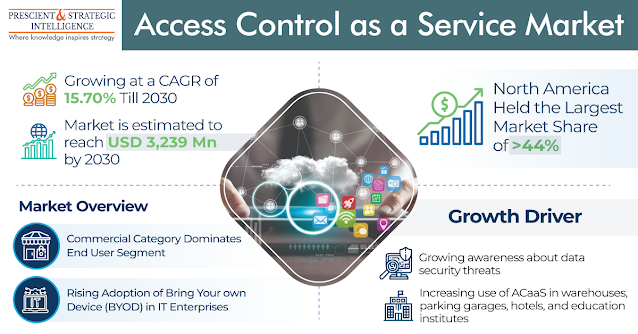
The access control as a service (ACaaS) market is experiencing growth and projected to reach USD 3,239 million by 2030.

What is ACaaS?

Access Control as a Service is a cloud-based solution that allows companies and individuals to handle and screen access to their houses remotely. Not like old-style access control systems that depend on on-site hardware and manual upkeep, ACaaS functions via the cloud, permitting operators to control access via a web-based channel or mobile application. This removes the requirement for wide wiring and upkeep, making it the best option for companies of all sizes.

The Simplicity Benefit

One of the most substantial benefits of ACaaS is its simplicity. Setting up old-style access control systems can be a difficult and time-taking task, involving software installations, ongoing management, and software installations. ACaaS, on the other hand, modernizes this procedure by providing plug-and-play solutions that need negligible technical skill.

With the help of ACaaS, managers can effortlessly add or remove users, screen activity in real-time, and regulate access levels. This level of control allows establishments to respond quickly to changing safety requirements, such as granting temporary access to contractors or revoking entry privileges immediately.

Cost-Efficiency and Scalability

ACaaS grants a cost-effective substitute to old-style access control systems. The cloud-based nature of ACaaS removes the requirement for wide hardware expenditure and maintenance expenses. Operators can subscribe to a service plan that suits their needs, paying only for the abilities they require.

Additionally, ACaaS provides unmatched scalability. As businesses develop or change, they can effortlessly expand their access control infrastructure without the bother of obtaining and installing extra hardware. This scalability is mainly advantageous for establishments with changing access requirements or several locations.

North America Is the Market Leader

Due to the growing demand for effective access control services to improve security systems in various commercial spaces, North America dominates the market for ACaaS with a market share of around 44%. In this regard, the rapid expansion of the regional market is driven by the rising rates of crimes, such as burglaries and B&Es.

The Future of Access Control

As technology is evolving constantly, Access Control as a Service is dignified to play an important role in paving the future of security management. With its accessible interfaces, cost-effectiveness, and advanced security features, ACaaS is becoming a progressively striking choice for businesses, residential developments, and even individual homeowners.

Hence, Access Control as a Service (ACaaS) has been perceived as a game-changer in the world of security management. Its cloud-based method streamlines access control improves safety, and provides lucrative scalability. As we navigate a world where ease and safety are most important, ACaaS stands as an encouragement of innovation, enlightening a path toward a more safe and unified future.