Machine Vision - Global Industry Share and Future Analysis

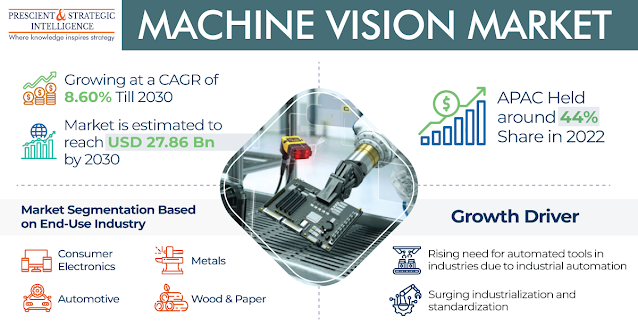
The global machine vision market is experiencing growth and is projected to reach USD 27.86 billion by 2030. 


The growth can be attributed to the increasing demand for quality inspection and automation across various industries, along with significant research and development investments by major players and advancements in technology.

In recent years, PC-based machine vision systems have dominated the market, holding a majority share of 56%, and are expected to maintain their leading position until 2030. These systems easily connect with cameras or image acquisition boards and feature customizable software, making them more user-friendly and versatile for a variety of camera applications. One such application is general inspection, such as checking for the presence of parts, like examining studs on a car's underbody at an auto body shop.

Mechanical systems guided by vision incorporate industrial automatons and machine vision devices, rapidly advancing due to their remarkable versatility, integration, and straightforward bin-picking capabilities. While fixed robotic measures were previously common, industrial robots equipped with this technology now efficiently direct goods to specific locations for additional operations like welding, placing, and picking.

The robotic cell category is expected to experience faster growth, progressing at a compound annual growth rate (CAGR) of 9.1% during the forecast period, primarily driven by the adoption of robots for sorting, picking, and other production-line tasks. This is attributed to advancements in deep learning, machine vision, and AI technologies, as well as the increasing availability of line scanning equipment.

In recent years, the food and packaging category had a significant machine vision market share and is also estimated to be in the same position during the forecast period. This is primarily because such systems are used for quality assurance, measurement, guidance, and positioning and identification propels the market.

Moreover, the rising global demand for packaged food and the increasing popularity of online shopping in developing nations are driving the need for retail e-commerce packaging, thereby necessitating such technology for packing tasks.

During the projection period, the APAC market will witness the fastest growth, developing at a CAGR of 9.7%. This can be ascribed to fast industrialization, the increasing automotive and industrial metro, and the rising acceptance of AI, robots, and ML by manufacturing establishments in nations such as India, China, and Japan.

China produces the mainstream of revenue in the regional industry. This is because of the wide manufacturing hub of electric goods where their tech is extensively utilized, the increasing automotive industry, and the high expenditure by international companies in research and development in the country.

Thus, the rising requirement for excellent examination and mechanization in diverse manufacturing verticals; and the growing R&D investment by major players, are key reasons propelling the machine vision market.

Fortify Your Companies Security with Wireless Testing

The wireless testing market is experiencing growth and is projected to reach USD 31.23 billion by 2030. This growth can be credited to the development of 5G networks throughout the world, the increase in demand from the consumer electronics market, and quick technological enhancements in wireless testing technologies.


What is Wireless Testing?

Wireless testing appraises electrical items that are proposed to function without wires – anything from computers and electric machines to industrial working with wireless components.

The Benefits of Wireless Testing

There are numerous advantages of conducting a wireless diffusion test. Classifying weaknesses that threat actors are able to exploit is dominant. Testing the efficiency of your safety posture or exposing inadvertent weaknesses permits an organization to remediate these problems before they happen for real. The increasing usage of the internet and growing acceptance of digital facilities have led to an extensive hike in the size of vital information being produced.

Types of Wireless Testing

There are numerous kinds of wireless testing, each catering to a unique drive:

Functional Testing: This finds if a device that is wireless or network performs its proposed purposes properly. For example, does your smartphone connect to Bluetooth? Can you make calls without nosiness?

Performance Testing: This checks the capacity, speed, and overall performance of wireless networks. It guarantees that your internet linking is rapid enough for streaming or gaming online.

Security Testing: Safety is a top worry in wireless tech. This kind of testing recognizes weaknesses and guarantees that your information stays safe from cyber-attacks.

Interoperability Testing: It checks that diverse wireless devices can function together flawlessly. For instance, can your smartphone connect to numerous Wi-Fi routers without problems?

The Wireless Testing Process

Wireless testing includes a set of steps:

Test Planning: Defining the purposes and possibilities of the testing procedure.

Test Design: Making test cases and situations to assess different features of wireless devices and networks.

Test Execution: Executing the tests and gathering information on performance, functionality, and safety.

Analysis and Reporting: Estimating the results and making reports to classify problems and areas for enhancement.

Re-testing: Fixing recognized problems and re-executing tests to guarantee they are fixed.

Furthermore, the increasing usage of the internet and growing acceptance of digital facilities have led to an extensive hike in the size of vital information being produced. Also, with this, there is a requirement for improving the set-up solutions, which is boosting the wireless testing market growth.

The Future of Wireless Testing

As technology continues to improve, the requirement for wireless testing will only advance. With the arrival of 5G, IoT devices, and smart metropolises, the requirement for dependable and safe wireless communication will be supreme. Meaning that the role of testing in wireless will become even more essential in guaranteeing the unified process of our interconnected realm.

Thus, the growth of 5G networks throughout the world, the increase in demand from the consumer electronics market, and quick technological enhancements in wireless testing technologies are the major factors driving the wireless testing industry. 

Smart Homes 2030: A $196.5 Billion Industry Revolution

The smart homes market will power at a rate of 10.2% by the end of this decade, to reach USD 196.5 billion by 2030. This will be because of the growing disposable income in emerging economies, increasing significance of remote home monitoring, increasing count of internet users, and rising acceptance of smart devices.


The entertainment category dominated the industry, and the situation will remain like this in the years to come. This would be because of the extensive diversity of solutions offered by tech providers for operating along with controlling the entertainment systems inside a house. 

For example, Alexa is able to control lights, televisions, and alarms, deliver sports scores, news and update users with other instantaneous info.

With the use of smart, energy-, and cost-effective devices, customers can lower the consumption of energy of their homes through automatic function settings and processes.

The industry growth is also encouraged by the considerable increase in the requirement for smart home healthcare solutions, growth in the acceptance of emerging technologies, for example IoT, in homes; and surge in the necessity for less-carbon-emitting solutions globally.

Furthermore, internet connectivity is combined with a number of medical devices for helping in monitoring the patient’s health and deliver an improved quality of nursing at their residences, thus reducing the requirement for the expensive healthcare services presented at hospitals, particularly for aging people.

North America will dominate the smart homes market by the end of this decade, as stated by P&S Intelligence.

The key factors powering the regional market are the expanding requirement for dependable and cost-effective home management systems, as well as cutting-edge safety and security systems; enhancing device standards, and increasing requirement for integrated smart devices, for example tablets, voice assistants, and IoT-supported devices.

The count of houses with this kind of appliances and systems in the region is greater than in supplementary regions, which is the important reason the region produces the highest revenue for product and software providers.

Worldwide, a number of countries are implementing green building policies, thus generating huge prospects for intelligent residential appliance and related software providers. In the years to come, the buildings constructed under green initiatives would be fortified with cutting-edge ecological techniques, with the main focus on the conservation of energy.

The robust initiatives taken by governments in a number of regions to inspire the expansion of green buildings and the progressions in data communication technologies and connected devices would, therefore, support the growth of the market growth.

Due to the increasing use of internet penetration around the world, the demand for smart homes will continue to grow by the end of this decade.