Ballooning Usage of Eco-Friendly Flame Retardants Fueling Global Bromine Market Boom

The global bromine market generated a revenue of $1,864.3 million in 2019. Furthermore, it will advance at a CAGR of 5.7% between 2020 and 2030, as per the estimates of P&S Intelligence, a market research company based in India. The market is being driven by the growing usage of bromine compounds for reducing mercury emissions, surging utilization of environment-friendly polymeric flame retardants, and the soaring adoption of clear brine fluids during drilling for oil and gas. 

Clear brine fluids are heavily used in gas and oil drilling activities, on account of their ability to reduce the temperature and bottom hole pressure in the borewells. Many soluble salts are added to them after taking into consideration the clarity, temperature/pressure freeze points, and freezing points of the wells. Brines exhibit high wellbore stability in the salt, lesser fine-hole formation, fill, and gauge damage, and faster shale penetration than the other fluids.

When application is taken into consideration, the bromine market is categorized into flame retardants, clear brine fluids, water treatment, and pharmaceuticals. Amongst these, the flame retardants category led the market in 2019, due to the fact that various bromine compounds such as ethyl bromide, allyl bromide, vinyl bromide, and ammonium bromide are extensively used in fire extinguishers and retardants. These chemicals not only help in putting out the fire, but they also reduce the flammability of the materials containing them. 

Across the globe, the Asia-Pacific (APAC) region is predicted to generate the highest revenue in the bromine market till 2030. This will be because of the surging urban population and the increasing disposable income of the people residing in the region. Additionally, the soaring demand for electronic and plastic products in the regional countries such as Japan, Thailand, South Korea, and China is also driving the market expansion, as bromine-based flame retardants are heavily used in these products.  

Hence, it is safe to say that the market will register rapid expansion in the upcoming years, mainly because of the surging requirement for clear brine fluids in oil and gas E&P activities and the rising popularity of polymeric flame retardants across the world.

Global Retail E-Commerce Packaging Market Revenue To Surge Above $60,000 By 2030

The global retail e-commerce packaging market was valued at $19,022.7 million in 2019, and it is expected to attain a revenue of $68,388.1 million by 2030. Furthermore, the market will progress at a CAGR o 12.1% from 2020 to 2030, as per the forecast of P&S Intelligence, a market research company based in India. The factors driving the expansion of the market are the increasing population in several countries and the growing affordability of smartphones and internet connections. 

Another major factor fueling the growth of the retail e-commerce packaging market is the increasing affordability of smartphones and internet connections, mainly because of technological advancements and innovations and the surging competition in the telecommunications industry in several countries. This is, in turn, driving the advancement of several digital industries such as e-commerce, which is subsequently propelling the demand for packaging products across the world, thereby powering the expansion of the market.

Besides the aforementioned factor, the changing buying behavior customers, the growing popularity of online channels, and the mushrooming adoption of advanced technologies by millennials are also driving the progress of the e-commerce industry and thus, fueling the sales of packaging products. In addition to these factors, the COVID-19 pandemic is also powering the growth of the retail e-commerce packaging market. This is because the pandemic is driving the penetration of the internet and smartphones and digitization all over the world.

Depending on material type, the market is divided into envelopes, boxes, and others, such as bubble wraps, tapes and labels, and air cushions categories. Amongst these, the boxes category contributed the highest revenue to the market from 2014 to 2019. Geographically, the Asia-Pacific (APAC) region held the largest share in the retail e-commerce packaging market in 2019, and this trend will continue in the coming years as well, primarily due to the thriving e-commerce industry in the region. 

Hence, it can be said without any hesitation that the market will surge sharply in the forthcoming years, mainly because of the increasing penetration of the internet and smartphones and the ballooning popularity of online shopping around the world.

Source: www.psmarketresearch.com

Increasing Electric Vehicle Deployment Adding Wings to Worldwide Graphite Demand

The increasing production of steel, due to the mushrooming requirement for steel products in end-use industries such as automotive, residential (household use), construction, and oil & gas, is fueling the global demand for graphite. As per the World Steel Association, the worldwide crude steel production increased from 1,814 million tons in 2018 to 1,869 million tons in 2019. Graphite exhibits high corrosion resistance and excellent strength and durability at extreme temperatures.

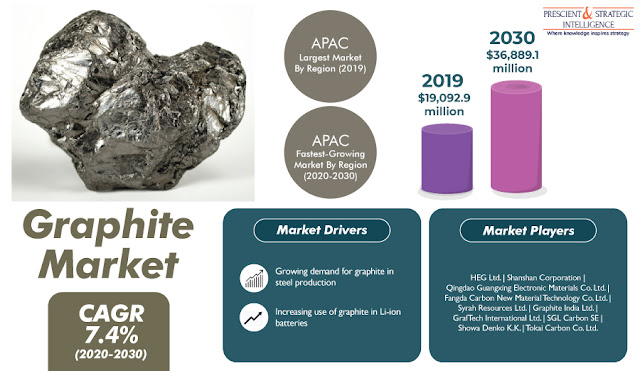
As natural graphite is cheaper than synthetic graphite and lithium titanate, the mushrooming sales of Li-ion batteries are driving the worldwide demand for graphite. This is, in turn, causing the expansion of the global graphite market. As a result, the revenue of the market is predicted to rise from $19,092.9 million in 2019 to $36,889.1 million by 2030. Furthermore, the market is predicted to advance at a CAGR of 7.4% from 2020 to 2030.

Depending on application, the market is divided into refractories, electrodes, foundries, lubricants, batteries, graphite shapes, and friction products categories. Out of these, the electrodes category dominated the graphite market in 2019. This was because graphite electrodes were used extensively in electric arc furnaces, as they were the primary heating elements. These furnaces were used during steel manufacturing, where scrap from old appliances or vehicles is melted for producing crude steel. 

Additionally, graphite electrodes have various beneficial traits such as the ability to withstand extremely high levels of heat and high electrical conductivity and are thus, extensively used in the steel manufacturing process. When end-use industry is taken into consideration, the graphite market is classified into automotive, metallurgy, and electronics categories. Out of these, the automotive category is predicted to hold the largest share in the market in the upcoming years.

Hence, it is safe to say that the demand for graphite will shoot up in the forthcoming years, primarily because of its increasing usage in the steel production process and Li-ion batteries and the mushrooming production of steel and the ballooning sales of Li-ion batteries, on account of the growing deployment of electric vehicles, across the world.

Source: www.psmarketresearch.com

Why Is Demand for Specialty Chemicals Tied to Booming Population?

Any non-food powder or liquid (excluding certain ingredients) can be vaguely termed a ‘chemical’, which gives an idea of how vast the concept and the number of substances classified as chemicals are. So, wherever there is industry, some or the other chemical would be in use. In turn, chemicals that are formulated for a specific purpose are generally called specialty chemicals. The concept includes agrochemicals, specialty coatings, construction chemicals, surfactants, polymer additives, food additives, electronic chemicals, plastic additives, cleaning chemicals, paper & textile chemicals, lubricant & oilfield chemicals, adhesives & sealants, advanced ceramic materials, water treatment chemicals, rubber processing chemicals, and mining chemicals.

P&S Intelligence considers such a wide application area of such products as the key factor that will drive the specialty chemicals market size to $980,423.7 million by 2030 from $639,935.8 million in 2019, at a 5.5% CAGR during 2020–2030 (forecast period). Even within specific industries, these chemicals have a wide range of applications. For instance, a large quantity of paper chemicals is consumed for packaging, printing, and labeling purposes. Overall, agrochemicals account for the heaviest consumption due to the booming population, which continues to push up the demand for food.

The specialty chemicals market has a fragmented nature, and its competitive landscape is characterized by an array of strategic measures, such as mergers, acquisitions, facility expansions, extensive research and development (R&D), product launches, partnerships, agreements, and collaborations. Key players in the market are Evonik Industries AG, Eastman Chemical Company, Ashland Global Holdings Inc., Akzo Nobel N.V., LOTTE Fine Chemical Co. Ltd., Mitsui Chemicals Inc., BASF SE, Huntsman Corporation, Mitsubishi Chemical Corporation, Clariant International Ltd., Dow Inc., China Petroleum & Chemical Corporation, Sadara Chemical Company, AECI Ltd., Saudi Basic Industries Corporation, and Thebe Unico.

Therefore, the burgeoning population will keep driving the consumption of a wide variety of specialty chemicals across an equally wide variety of industries.

Why are Coding and Marking System Sales Booming in India?

The surging requirement for making products traceable is fueling the demand for coding and marking systems in India. Moreover, the growing public awareness about the importance of mentioning drug information on the package, soaring popularity of blister packaging, and mushrooming use of packaging for ensuring safety, especially in the pharmaceutical industry, according to government regulations, are propelling the demand for coding and marking systems in the country. For example, the Food Safety Standards Authority of India (FSSAI) issued a regulation called the Food Safety and Standards (Organic Foods) Regulations in 2017.

This regulation came into effect on July 1, 2018. As per this regulation, manufacturers must print the ‘Jaivik Bharat” logo on their products. As coding and marking systems are extensively used in the manufacturing and packaging industries in India, the expansion of these industries is pushing up their sales in the country. The packaging industry is booming because of the soaring usage of innovative packaging methods such as flexible packaging, primarily due to the increasing requirements of the middle-class populace in the country.

Additionally, the growth of the e-commerce industry, on account of the rising internet penetration and increasing usage of smartphones, is also creating lucrative growth opportunities for the players operating in the Indian coding and marking systems market, thereby fueling the expansion of the market. As a result, the market revenue is predicted to rise from $49.8 million in 2019 to $136.5 million by 2030, while the market will exhibit a CAGR of 9.8% from 2020 to 2030. 

The most prominent companies in the Indian coding and marking systems market are Dover Corporation, Danaher Corporation, Control Print Limited, Domino Printing Sciences plc, RYNAN Technologies Pte Ltd., and Hitachi Ltd.

Key Findings of India Coding and Marking Systems Market Report

Stringent packaging regulations increasing demand for coders and markers

Coding and marking systems also being used to track products through supply chain

Growing packaging and manufacturing sectors driving market growth

TTO technology to witness fastest rise in popularity among users

Market consolidated owing to presence of handful of players

Digital printing solutions are key market trend

Read More: https://www.psmarketresearch.com/market-analysis/india-coding-and-marking-systems-market

Why Are Adhesives Producers Using Crotonic Acid Comonomer?

Crotonic acid is one of the vital ingredients used in the production of paints and coatings, due to its ability to develop copolymers when mixed with other chemical compounds. Additionally, crotonic acid monomer is also used for the formulation of a thickener, which is utilized in the production of glossy emulsion paints. These paints provide extra glowing effects and protective coatings to the interiors and exterior of buildings. Thus, the surging use of paints and coatings, owing to the booming construction and infrastructure industries, will fuel the adoption of crotonic acid in the coming years.

Moreover, the flourishing adhesives industry will help the crotonic acid market to grow at a CAGR of 7.9% during 2021–2025. According to P&S Intelligence, the market revenue stood at $592.0 million in 2020 and it is projected to reach $853.7 million by 2025. Huge quantities of the acid are used as a comonomer with vinyl acetate in the adhesive sector. The copolymers resulting from this chemical reaction are used in the formulation of acids. For example, hot melt adhesives are usually developed by grafting crotonic and acrylic acids onto metallocene ethylene–octene copolymers.

Geographically, China dominated the crotonic acid market in the recent past, and it is expected to retain its dominance in the coming years as well. Additionally, the country is also expected to consume crotonic acid at the highest rate in the foreseeable future. This can be attributed to the burgeoning demand for paints, coatings, and adhesives for the repair and renovation of residential and commercial buildings in the country. Moreover, the surging use of the acid as plasticizers, fungicides, and intermediates in the chemical, agriculture, and pharmaceutical industries, respectively, will augment the consumption of crotonic acid in the country in the coming years.

Thus, expanding paints and coatings and adhesives industries and burgeoning demand for automobiles will amplify the need for crotonic acid in the foreseeable future.

How Is Petrochemical Production Boosting Methanol Market Growth?

The high-volume consumption of methanol in the production of a wide range of petrochemicals is expected to support the methanol market growth, worldwide. According to P&S Intelligence, the market generated a revenue of over $20 billion in 2020. Moreover, the rising adoption of methanol as an alternative fuel in vehicles, on account of the increasing environmental concerns, will drive the demand for the chemical during the forecast period (2021–2030). 

The surging demand for petrochemicals will boost the need for methanol in the foreseeable future, as the chemical is used in the manufacturing of several petrochemicals, such as acetic acid, olefins, formaldehyde, solvent, dimethyl ether (DME), methyl methacrylate (MMA), and methyl tert-butyl ether/tert-amyl methyl ether (MTBE/TAME). These products are widely used in the construction and automotive industries. Moreover, the growth of the construction and automobile sectors, primarily on account of the booming population and soaring disposable income, will augment the demand for methanol in the foreseeable future.

At present, companies operating in the methanol market are primarily focusing on facility expansion to ameliorate their market position and amplify R&D activities. For instance, in June 2020, Assam Petro-Chemicals Limited (APL) announced its plan to produce 500 tons of methanol per day from the second quarter of 2021. Other key players focusing on facility expansion include Mitsubishi Gas Chemical Company Inc., LyondellBasell Industries N.V., OQ SAOC, QAFAC, OCI N.V., Petroliam Nasional Berhad (PETRONAS), Celanese Corporation, and SABIC.

In the coming years, the Asia-Pacific (APAC) region will account for the largest share in the methanol market, globally, due to the flourishing petrochemical industry and rising consumption of methanol-based fuel in Japan, China, and India. Among APAC nations, China is the leading consumer of methanol, due to the strong presence of various end-use industries in the nation. Besides, the mounting automobile production, booming electronics industry, and soaring construction activities, especially in India and China, will support market growth in the region.

Thus, the expanding petrochemical industry and the increasing focus of market players on developing new and sustainable methanol production methods are expected to fuel the market growth in the forecast years.

Source: www.psmarketresearch.com