Demand for Sodium Sulphate Set to Explode in Asia-Pacific in Future

Sodium sulphate is an inorganic salt that is primarily used in the production of glass, which is being increasingly used in the construction sector. In recent years, the expansion of the construction industry has created an extensive requirement for glass, owing to which, the production of sodium sulphate has escalated rapidly. Nowadays, the industry is using larger volumes of glass, as compared to cement and bricks, in the construction of modern buildings. Glass manufacturers use sodium sulphate as a fining agent to remove minute air bubbles from molten glass.

In addition, the soaring demand for powdered detergents from emerging economies of Asia-Pacific (APAC), Latin America (LATAM), and Africa, including Thailand, India, the Philippines, Vietnam, China, Colombia, Indonesia, Chile, and Brazil, is expected to drive the sodium sulphate market at a CAGR of 2.6% during the forecast period (2019–2024). The market revenue stood at $2,019.3 million in 2018 and it is projected to exceed $2,109.4 million by 2024. The rising usage of detergents in such countries can be ascribed to the shift from hand to machines for washing clothes and macroeconomic growth of these countries.

In recent years, sodium sulphate manufacturers, such as MINERA DE SANTA MARTA S.A., Nafine New Material Co. Ltd., Xinli Chemical, Grupo Industrial Crimidesa, and Jiangsu Yinzhu Chemical Group Co. Ltd., have been largely focusing on geographical expansions, product launches, and mergers and acquisitions to cater to a vast consumer base. For example, in November 2018, an independent private equity firm, Beautiful Mind Capital (BMC), acquired Cordenka from Chequers Capital, with an investment of $268 million. The latter will transfer all its assets, including its Obernburg site, which produces 40,000 metric tons of anhydrous sodium sulphate.

According to P&S Intelligence, the APAC region consumed the highest quantity of sodium sulphate in the past few years, and it is expected to retain its dominance in the coming years as well. This can be primarily owed to the large-scale consumption of the inorganic salt in China for the production of textiles and soaps and detergents. Additionally, the surge in the personal care sector in China is augmenting the demand for sodium sulphate, as it is required for manufacturing soap bars, shampoos, body washes, and several other hygiene and personal care products.

Thus, the mounting demand for glass, soaps, and detergents in various parts of the world will boost the need for sodium sulphate in the coming years.
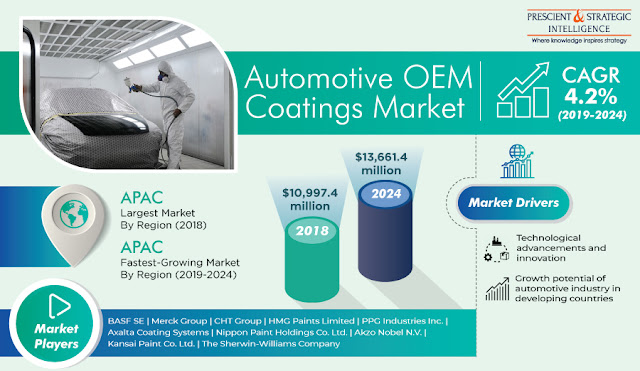
Increasing Automobile Production Fueling Demand for Automotive OEM Coatings

A number of factors such as the rising technological advancements and innovations and expanding automotive industry in the developing countries will drive the automotive original equipment manufacturer (OEM) coatings market at a CAGR of 4.2% during the forecast period (2019–2024). The market was valued at $10,997.4 million in 2018 and it is projected to reach $13,661.4 million revenue by 2024. In recent years, the surging preference for powder coatings over liquid coatings has become a prominent market trend, due to the lower content of volatile organic compounds (VOCs) in the former.

One of the key growth drivers of the automotive OEM coatings market is the increasing technological advancements being made in automotive OEM coatings in the Asia-Pacific (APAC) region. Coating manufacturing companies in APAC are largely focusing on developing novel products, processes, and technologies to meet the ever-changing demands of automakers. Automobile manufacturers are opting for coatings with greater functionality, low maintenance cost, and reduced emissions. The end users are looking out for advanced coatings to comply with the stringent government regulations.

Moreover, the flourishing automobile industry in countries such as Indonesia, India, and Thailand will also contribute to the market growth in the coming years. The mounting sales of four-wheeler and two-wheeler vehicles in these countries, primarily on account of the escalating purchasing power and improving road connectivity and infrastructure, are driving the demand for these coatings in these Southeast Asian nations. Additionally, the growing strategic alliances between automakers will also fuel the expansion of the market in the forecast years.

Globally, Asia-Pacific (APAC) will account for the largest share in the automotive OEM coatings market throughout the forecast period, while progressing at the highest rate. This can be primarily credited to the presence of leading automobile companies in the region, particularly in India, China, and Indonesia. Among APAC nations, China will generate the highest revenue in the market in the foreseeable future, due to the large-scale production of vehicles in the region. According to the International Trade Administration, the annual domestic automobile production in China will reach around 35 million units by 2025.

Thus, the increasing technological advancements being made in the APAC automotive industry and prospering automobile sector in developing countries will support the market growth in the immediate future.

How Is High Energy Consumption Fueling Net Zero Energy Buildings Construction?

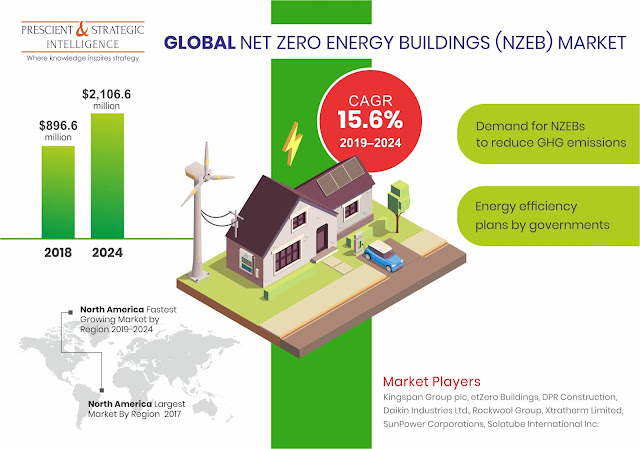
Net zero energy buildings (NZEBs) refer to highly efficient buildings having extremely low energy requirements, that is met by non-conventional energy sources. These structures produce as much energy as they consume annually. To attain their net zero energy goals, buildings must reduce their energy demands by using energy-efficient technologies and utilize non-conventional energy sources to meet the remaining demand. Owing to these properties of NZEBs, governments across the world are taking numerous initiatives to reduce the usage of fossil fuels in residential and commercial buildings. 

Moreover, the surging focus on reducing greenhouse gas (GHG) emissions during electricity production is expected to drive the net zero energy buildings market at a CAGR of 15.6% during the forecast period (2019–2024). According to P&S Intelligence, the market revenue is projected to increase from $896.6 million in 2018 to $2,106.6 million by 2024. According to the World Green Building Council, the construction industry accounts for over 35% of global energy consumption and around 40% of the energy-based carbon dioxide emissions.

Globally, North America accounted for the largest share in the net zero energy buildings market in 2018 and it is projected to exhibit the fastest growth throughout the forecast period. The mounting concerns regarding GHG emission, owing to the increased burning of fossil fuels for electricity generation, will boost the construction of NZEBs, as these buildings can reduce pollution during the construction phase and ensure carbon neutrality. Moreover, the energy consumption targets set by the governments of Canada and the U.S. to attain sustainable energy demand will also support the market growth in the region.

Thus, the accelerating need to meet the high energy demand and curtail GHG emission from the construction sector will augment the construction of NZEBs in the foreseeable future.

Booming Manufacturing Activities Driving Metal Bonding Adhesive Sales in India

The expansion of the manufacturing sector is propelling the sales of metal bonding adhesives in India. As per the India Brand Equity Foundation, the manufacturing sector in India boomed during April 2000–June 2019 and reached a value of $91.2 billion in 2019, mainly due to the surge in foreign direct investments. Additionally, several government initiatives such as ‘Make in India’ have fueled the growth of this sector, thereby creating new avenues for manufacturing firms and for the use of advanced industrial equipment. This is subsequently pushing up the requirement for metal bonding adhesives.

Owing to their low weight, these lightweight adhesives are also being increasingly used in ships and aircrafts. Another major factor fueling the demand for metal bonding adhesives in India is the growth of the healthcare industry. Due to the surging healthcare expenditure of the government, the country’s healthcare industry is predicted to attain a value of $372 billion by 2022. As metal bonding adhesives are heavily used for producing healthcare equipment such as surgical instruments, X-ray machines, implantable devices, and biosensors, the boom in the healthcare industry is positively impacting their sales.

Due to the above-mentioned factors, the value of the Indian metal bonding adhesives market is predicted to rise from $198.9 million in 2019 to $343.6 million by 2030. The market is also expected to advance at a CAGR of 5.2% between 2020 and 2030. Epoxy, acrylic, cyanoacrylate, anaerobic, rubber, and polyurethane are most commonly used metal bonding adhesives in India. Out of these, the demand for epoxy adhesives is predicted to rise at the highest rate in the country in the forthcoming years.

This is credited to the growing adoption of epoxy adhesives for joining the metal sheets used in automobiles and trains. Moreover, these adhesives have features such as high resistance to extreme temperatures, moisture, chemicals, oil, stress, and various other solvents, and are highly compatible with several metals. Automotive, industrial machinery, industrial maintenance, consumer appliances, and construction are the major application areas of metal bonding adhesives in India. Out of these, the usage of these adhesives was the highest in automotive applications in the past years, and this trend will continue in the upcoming years as well.

Thus, it is clear that due to the expansion of the manufacturing, automotive, and healthcare sectors, the sales of metal bonding adhesives will rise tremendously in India in the coming years.

Rapid Shift toward Biofuels Driving Fatty Acid Ester Demand

The increasing consumption of personal care products and cosmetics, owing to the surging female working population and escalating consciousness about physical appearance, will create a huge requirement for fatty acid esters in the forthcoming years. These chemicals are being increasingly used as detergent cleansing agents and as emollients and thickeners in skin creams. Additionally, the rising customer awareness about bio-based cosmetics will fuel the consumption of such esters in the personal care and cosmetics industry.

Moreover, the usage of such chemicals as lubricant additives in automotive, metal cutting, and hydraulic applications will help the fatty acid esters market advance at a 4.6% CAGR during 2020–2030. According to P&S Intelligence, the market was valued at $2,240.9 million in 2019, and it is expected to generate $3,688.9 million revenue by 2030. The rapid shift toward bio-based fatty acid esters can be credited to their lower toxicity and excellent lubricity.

At present, fatty acid ester manufacturers are engaging in mergers and acquisitions and geographical expansions to enhance their customer base. For example, in February 2018, KLK Oleo completed the acquisition of Elementis Specialties Netherlands B.V., which manufactures fatty acid polyglycol esters and other chemical products, to strengthen its downstream chemical specialties business in Europe. Furthermore, in 2019, Matangi Industries announced its plan to expand the production capacity of fatty acid esters to 14,400 tons annually.

Apart from these two companies, Esterchem Ltd., Tokyo Chemical Industry Co. Ltd., American eChem Inc., Temix Oleo Srl, and Oleon NV are offering oleates, dimerates, laureates, pelargonates, stearates, palmitates, and tall oil fatty acid (TOFA)-based esters for the lubricants, food additives, personal care, and industrial solvents and additives industries. Nowadays, oleates are consumed in the largest volume due to their increasing application in personal care products, pharmaceutical solvents, and lubricants, owing to their exceptional lubrication, excellent cold flow, and low toxicity and volatility.

Therefore, the burgeoning demand for personal care products and biofuels will propel the consumption of fatty acid esters.

Soaring Demand for Lubricants Strengthening 300–450 TBN Calcium, Barium, and Magnesium Sulphonates Market Growth

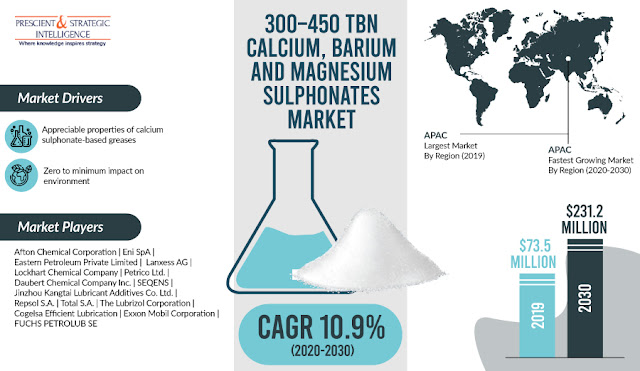
The 300–450 TBN calcium, barium, and magnesium sulphonates market is expected to exhibit a CAGR of 10.9% during the forecast period (2020–2030), due to the increasing preference of lubricant producers for calcium sulphonate over lithium sulphonate. Additionally, the beneficial properties of calcium sulphonate greases will also help the market revenue to surge from $73.5 million in 2019 to $231.2 million in 2030. At present, the key players in the market are focusing on mergers and acquisitions and partnerships to expand their product portfolio and geographical reach.

The market is currently driven by the surging preference of lubricant manufacturers for calcium sulphonate over lithium sulphonate for grease production, owing to the implementation of numerous environmental protection legislations. The increasing use of calcium sulphonate as a thickener in grease-based products, such as automobile and industrial lubricants can be credited to its high mechanical and shear strength and dropping point. Moreover, the exceptional resistance of the salt to oxidation, temperature, wear, and water also makes it ideal for being used as a thickener in lubricants.

Globally, Asia-Pacific (APAC) is expected to hold the largest share in the 300–450 TBN calcium, barium, and magnesium sulphonates market throughout the forecast period. This will be due to the burgeoning demand for passenger cars and commercial vehicles in the region. The turbocharged direct-injection engines being deployed in passenger cars require greases and lubricants with strong additives, such as calcium sulphonate. Moreover, the rapid economic progress of India and China and the booming industrial sector will also augment the demand for calcium, magnesium, and barium sulphonates in the region in the coming years.

Thus, the increasing use of calcium sulphonate in grease production will augment the market growth in the foreseeable future.

Global Sales of Organic Fertilizers Predicted to Explode in Future

The proliferation of huge organic foods and beverages retail markets in Europe and North America is boosting the demand for organic fertilizers across the globe. As per the observations of the International Federation of Organic Agriculture Movement (IFOAM), in 2019, the sales of organic items were majorly concentrated in Europe and North America for a short period of time. The sales of these products were considerably in countries such as France, the U.S., and Germany. 

This was mainly due to the high per capita income of the inhabitants of these countries. Moreover, as per the IFOAM, the demand for these products would climb in the forthcoming years, which will, in turn, growth opportunities for the organizations operating in the global organic fertilizers market in the future. The surging acreage and the number of organic farmlands is also pushing up the demand for organic fertilizers all over the world. 

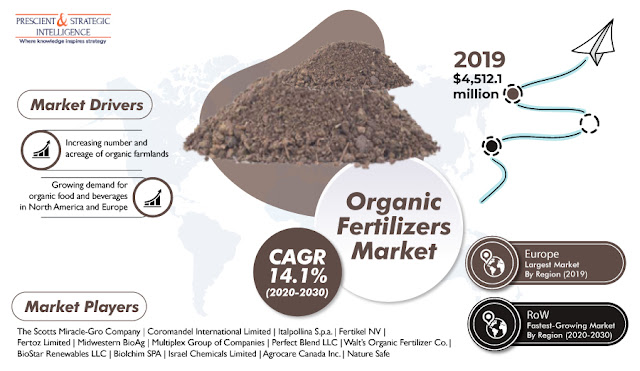
This is subsequently driving the expansion of the global organic fertilizers market. The market value is predicted to grow from $4,512.1 million in 2019 to $14,746.2 million in 2030. Industry experts predict that the market would exhibit a CAGR of 14.1% from 2020 to 2030. The major sources of these materials are animals and plants. Of these, the sales of animal-based fertilizers were found to be higher in the last few years.

Across the globe, the organic fertilizers market would demonstrate the fastest growth in the Rest of World (RoW) region in the upcoming years, as per the estimates of P&S Intelligence, a market research firm based in India. The biggest factor fueling the rapid advancement of the market in this region is the large-scale farming of quinoa, especially in the Latin American (LATAM) countries such as Uruguay, Argentina, and Mexico. This is because organic fertilizers are heavily used in quinoa farming.

Thus, it can be said with full confidence that the sales of organic fertilizers would shoot-up all over the globe in the years to come, primarily due to the rising demand for organic foods and beverages in various countries across the world.