How Is Infrastructure Development Supporting Saudi Arabia Facility Management Market Growth?

Factors such as surging construction activities and flourishing tourism industry are expected to accelerate the Saudi Arabian facility management market at a CAGR of 11.1% during the forecast period (2021–2030). According to P&S Intelligence, the market was valued at $31,264.1 million in 2020 and it is projected to reach $87,216.0 million by 2030. The market growth is also supplemented by the increasing investments in infrastructure development. Moreover, the trends of energy monitoring, robot usage, and heating, ventilation, and air conditioning (HVAC) optimization are also supporting the market growth.

The bolstering infrastructure industry, primarily on account of rising number of ongoing and upcoming construction plans, will support the demand for facility management services in Saudi Arabia in the coming years. Also, increasing investments in the infrastructure sector and rising government support for infrastructure development will fuel the market growth. For instance, in January 2019, the government unveiled its plan to invest $426 billion by 2030 to develop infrastructure and end-use industries.

The Saudi Arabian facility management market is characterized by the presence of numerous players, who have entered into small contracts, in recent years, to offer services at mega-infrastructure units, such as Amaala, Qiddiya, and King Salman Park. Apart from this, the companies are also aiming at landing bigger contracts to gain a competitive edge in the market. For instance, in August 2020, APSG Group announced that it has successfully started the provision of maintenance, hospitality, and cleaning services at Alrajhi Bank’s more than 150 branches and 612 ATMs in the southern part of Saudi Arabia.

Thus, the booming tourism sector and the strengthening infrastructure industry will support the market growth in the coming years.

How Are Brownfield Discoveries Driving Digital Oilfield Technology Usage?

During 2017–2018, electricity production from coal, natural gas, and crude oil grew by 370 million tonnes of oil equivalent (Mtoe), driving the global electricity generation during this period, says the International Energy Agency (IEA). Thus, despite the focus shift toward renewable energy, fossil fuels continue to hold the largest share in the earth’s energy mix. This is perhaps because power production from these sources requires technologies that have been known for over one century. Moreover, renewable technologies require a high investment, and many of them don’t produce electricity as efficiently; solar plants don’t work at night, while wind plants can only work on really windy days.

Thus, with the rising oil and gas exploration and production (E&P) activities, the digital oilfield technology market size will likely grow from $26,570.4 million in 2017 to $34,871.6 million by 2023, at a 4.6% CAGR between 2018 and 2023. This will be because with the aging of oil and gas fields, the pressure with which the commodities rise to the surface decreases, which creates the need for advanced technology to keep the production volume economically feasible. Moreover, a number of brownfield reserves are being discovered, which have already matured, thus require digital technologies to boost production.

Presently, Europe and North America are the two largest contributors to the digital oilfield technology market because of their huge oil and gas reserves. The U.S. and Russia account for some of the largest oil and gas reserves and E&P volumes. Although Venezuela in South America is said to have the largest proven oil reserves, its production volume is quite low due to it being a developing country with primitive technology, which is not suitable for mass production.

Other than North America and Europe, the Middle East and Africa (MEA) is another potential user of the digital oilfield technology. For a region the very economy of which is built around oil, the Middle East could potentially generate a huge demand for such solutions. Among the top 10 countries with the largest proven oil reserves in the world are Saudi Arabia, Iran, Iraq, Kuwait, the U.A.E., and Libya, all in the MEA region.

Hence, with oil and gas continuing to power humanity, the demand for advanced technologies that can help boost their production will only rise.

Why Is APAC Consuming Pressure Sensitive Adhesives In Abundance?

Pressure sensitive adhesives refer to elastomer copolymers or elastomers that are slightly crosslinked and strongly bond with a substrate. These adhesives do not undergo a liquid-to-solid transition to hold substances together. This class of adhesives can be synthetic or solvent-free natural resins having a viscoelastic property named 'tack'. Tack refers to the rapid wetting of a substrate by a polymer to create an adhesive bond during brief contact with the substrate under light pressure. Major advantages of these adhesives are environmental durability and instant bonding.

One of the key growth drivers for the pressure sensitive adhesives market is the flourishing e-commerce sector. The prospering e-commerce industry, on account of the changing customer preferences and mounting purchasing power of people, is creating a huge requirement for packaging materials, especially paper board. This factor will, therefore, drive the market at a CAGR of 4% during 2019–2024. The market revenue stood at $7,414.0 million in 2018 and it is projected to reach $9,351.8 million by 2024.

According to P&S Intelligence, Asia-Pacific (APAC) held the largest share in the pressure sensitive adhesives market during the historical period (2014–2018), and it is expected to maintain this trend throughout the forecast period. This can be primarily attributed to the expanding construction, electronics, packaging, and automotive industries in the region. As China, Japan, and South Korea are the leading manufacturers of electronics in the world and India and China are two of the largest consumers of fast-moving consumer goods (FMCG) products, these countries create a significant demand for packaging materials such as pressure sensitive adhesives.

There, the booming e-commerce sector and surging number of mergers and acquisitions among pressure sensitive adhesive producers will augment the adoption and production of pressure sensitive adhesives in the foreseeable future.

Demand for Proppants To Soar in Asia-Pacific in Coming Years

With the surge in fracturing activities, on account of the discovery of new reservoirs of shale gas, the requirement for frac sand, which is a proppant, is rising sharply. As per the Railroad Commission of Texas (RRC), the number of wells that were completed during January–March 2017 was 1,925 and this number will rise to 2,712 during January-March 2018. This subsequently increased the requirement for frac sand. According to various reports, the demand for the material is predicted to rise from 45 million tons in 2016 to 110 million tons in 2018. 

This material is needed to break the pores in the reservoir for creating a vent, which will allow the shale gas to flow up to the surface. As frac sand is cheaper than other proppants, it is widely used all over the world. Besides this factor, the development of environment friendly and non-phenolic resin-coated materials is also creating lucrative growth opportunities for the players operating in the proppant market. As the phenolic-based resin-coated material causes various environmental issues such as the contamination of water, many companies like the Dow Chemical Company and Preferred Sands are developing non-phenolic resin-coated materials, which are highly eco-friendly.

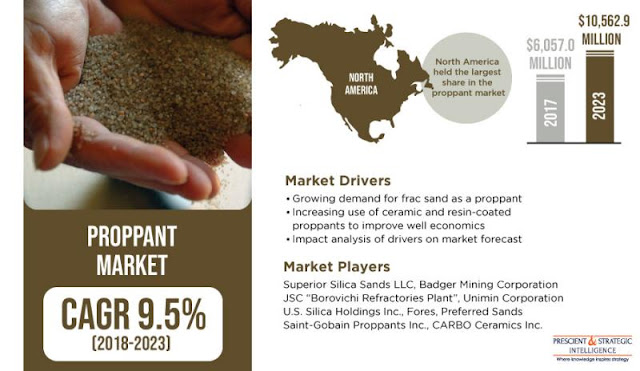
Apart from being environment-friendly, these materials also require less energy during the production process. As a result, they are being increasingly used in the oil and gas industry. Because of these factors, the proppant market is predicted to exhibit a CAGR of 9.5% from 2018 to 2023, while the market revenue will surge from $6,057.0 million in 2017 to $10,562.9 million by 2023, as per the estimates of the market research company, P&S Intelligence.

Thus, it can be said with surety that the demand for proppants will rise enormously in the coming years, primarily because of the surging usage of frac sand in fracturing activities, which are themselves booming owing to the discovery of various shale gas reservoirs, and increasing production of natural gas in several countries.

Growing Homeownership Rate Driving Consumption of Paints and Coatings

People not only care for their own appearance but also that of the things they own, such as houses and automobiles. Thus, with the booming population pushing up the requirement for houses, vehicles, and a host of other practical and materialistic things, the paints and coatings market has a bright future ahead. As per P&S Intelligence, the sale of such materials valued $156,086.2 million in 2019, and this revenue is set to witness a 4.2% CAGR during 2020–2030, to reach $227,834.0 million by 2030.

To accommodate the growing population, especially in Sweden, China, the U.S., India, Australia, Canada, and the U.K., residential, civil, commercial, and industrial infrastructure development projects are increasing in number. For instance, the Indian government allocated $24.27 billion (INR 1,69,637 crore) in the 2020–21 Union Budget for transport infrastructure development, which would boost the demand for paints and coatings. Similarly, smart cities are under construction around the world for conserving resources and making the world more sustainable, which is again creating a huge requirement for paints and coatings.

The other major sector that consumes these materials in vast volumes is automotive. The look of the car is one of the most-vital aspects that encourage someone to buy it; therefore, automakers continue to go overboard with their paint job. Any vehicle requires at least four layers of coating: primer, basecoat, electrocoat, and clearcoat, for aesthetic value and protection from the elements. Thus, with auto sales and production booming in emerging economies, the demand for paints and coatings is rising.

Thus, owing to the burgeoning automobile sales and homeownership rate, Asia-Pacific (APAC) generates the highest revenue in the paints and coatings market. China, Japan, India, and South Korea account for the highest sales and production figures of automobiles globally due to their booming population and rising urbanization rate. Moreover, regional governments are implementing several policies to make housing affordable, which is another reason behind the rising consumption of such materials.

Hence, with the booming homeownership rate and automobile sales, the demand for paints and coatings, especially the technologically advanced ones, will keep shooting up.

Due to the deteriorating soil quality, owing to deforestation, excessive mining, and extensive usage of chemical fertilizers, researchers are suggesting products such as biochar which can mitigate nitrogen leaching in ground water, increase the water absorption ability in soil, boost microbial count in soil, and reduce soil acidity. Additionally, the growing demand for greater agricultural productivity, on account of the surging need for more food products because of the soaring population in several countries, is fueling the requirement for biochar.

Besides the aforementioned factors, the implementation of stringent environmental policies, growing demand for better soil fertility, and increasing enactment of government initiatives aimed at augmenting the crop yield are also pushing up the demand for biochar across the world. Biochar is utilized as a soil amendment and assists in enhancing soil fertility and retaining the quantity of carbon in soil. Although the char extracted from wild fire also helps in enhancing soil fertility, its usage remains limited, owing to the fact that wild fire leads to environmental contamination, deforestation, and greenhouse gas emissions. 

Because of the aforementioned factors, biochar is being increasingly used in farming processes, which is, in turn, driving the expansion of the biochar market. The revenue of the market reached $4.27 million in 2015 and the market is predicted to exhibit a CAGR of 17.1% from 2016 to 2023 (forecast period), as per the estimates of the market research company, P&S Intelligence. Biochar is produced via pyrolysis and gasification processes that include super heating of biomass in the presence of limited amounts of oxygen at high temperatures and thermal conversion.

Thus, owing to the growing demand for higher crop productivity, because of the burgeoning requirement for more food products, and the soaring demand for better soil quality and texture, the usage of biochar is surging sharply in farming processes across the world. 

Adhesives and Sealants Enhancing Automotive Safety

Automakers across the world are making notable investments in the research and development (R&D) on lightweight vehicles to enhance their fuel efficiency and maximize their power and speed. To reduce the overall vehicle weight, automobile manufacturers are replacing steel fixtures, such as nuts and bolts, with structural adhesives, which provide exceptional bonding. Thus, the burgeoning demand for lightweight vehicles, owing to the depleting fossil fuel reserves, will create a huge requirement for automotive adhesives and sealants worldwide.

Additionally, the rising implementation of stringent vehicle safety standards and regulations by numerous governments will drive the automotive adhesives and sealants market at a CAGR of 7.0% during the forecast period (2020–2030). The market was valued at $7,438.2 million in 2019, and it is projected to generate $12,646.8 million by 2030. As adhesives can absorb the impact of head-on collisions, rubber compounds are being used in non-structural application areas, during the body in white (BIW) stage, to fill the vacuum in vehicles. These compounds help in shock absorption, which is essential for passenger safety.

According to P&S Intelligence, Asia-Pacific (APAC) accounted for the largest share in the automotive adhesives and sealants market in 2019, and it is also expected to demonstrate the fastest growth throughout the forecast years. This can be credited to the accelerating economic growth, mounting purchasing power of the middle-class population, and developing urban infrastructure in the region. Moreover, the increasing focus of governments, automakers, and the public on minimizing carbon emissions and enhancing the fuel economy of vehicles will augment the demand for such fasteners in the region.

Thus, the mushrooming demand for lightweight vehicles and increasing implementation of vehicle safety norms will propel the consumption of automotive adhesives and sealants.