Why is Worldwide Demand for UV-cured Printing Inks Surging?

The surging requirement of printing inks in several end-use industries, such as advertising, labeling, and packaging, is fueling their sales across the world. With the increasing gross domestic product (GDP) of many countries, surging disposable income of people, mushrooming population of young individuals, and rapidly changing lifestyles of people, the demand for packaged products is soaring, which is, in turn, driving the expansion of the packaging industry. This is subsequently fueling the requirement for printing inks.

The adoption of printing inks in the packaging industry is predicted to soar in the coming years, primarily because of their growing requirement in labels and tags, flexible materials, and metal cans. Besides, the rising demand for ultra violet (UV)-cured printing inks is also propelling their sales across the world. These printing inks provide low heat generation, zero ozone generation, long service life, and energy efficiency. Moreover, these printing inks are environment-friendly. 

Organizations, such as Co. KGaA and Siegwek Druckfarben AG are increasingly focusing on producing innovative and environment-friendly printing inks, such as UV-cured inks and water-based inks in order to achieve short production time and optimal efficiency. Furthermore, the growing public awareness about the benefits of using flexible printing products in directories, periodicals, inserts, catalogs, and magazines is also driving the expansion of the global printing inks market.

Globally, the sales of printing inks were observed to be the highest in North America in the years gone by. In this region, the demand for these inks was the highest in the U.S. during the last few years. On the other hand, in the Asia-Pacific (APAC) region, the sales of these inks were the highest in China, while Germany dominated the European printing inks market in the past years. Additionally, in Latin America, Brazil witnessed the highest demand for these inks, while Turkey registered the highest sales of these inks in Middle East and Africa during the past few years. 

Hence, it can be said without any hesitation that the demand for printing inks will surge sharply in the coming years, mainly because of their growing requirement in various end use industries, such as packaging and advertising.
Why Are Acrylic Surface Coatings Beneficial for Environment?

Low levels of volatile organic compounds (VOCs) in acrylic surface coatings have led to the increased adoption of such coatings. This can be ascribed to the growing awareness about harmful effects of VOCs like cancer and respiratory illnesses. Moreover, the amplifying environmental concerns, has encouraged manufacturers and customers to shift toward acrylic products. On account of these reasons, governments of various countries have amended norms to lower VOC emission levels. Thus, they are implementing stringent regulations to coerce the manufacturers to develop eco-friendly coatings.

Moreover, increasing usage of coatings for decorative purposes will escalate the acrylic surface coating market at 5.2% CAGR during forecast period. The market was valued at $24,121.1 million in 2015 and it is expected to reach $34,720.3 million by 2022. These coatings are used for amplifying the aesthetic value of vehicles, interior and exterior walls, and furniture. High volume adoption of decorative coatings can be owed to the rapid urbanization and surge in disposable income, globally. Moreover, rising investments in the infrastructure sector, especially in developing nations, will boost the utilization of acrylic surface coatings in the foreseeable future.

According to P&S Intelligence, Asia-Pacific (APAC) will lead the acrylic surface coating market in the coming years, while displaying the fastest growth. This can be attributed to the vast consumer base, stringent norms for utilization of environment-friendly coatings, and huge investments in the infrastructure sector. Besides, the growing automotive industry and rising purchasing power of people in the region will propel the adoption of acrylic surface coatings in the future. For instance, China is one of the leading automobile manufacturing hubs, which uses a large quantity of coatings to enhance the aesthetic appeal of vehicles produced in the country.

Thus, the environment-friendly nature of acrylic surface coatings will boost their application in the automobile, construction, and furniture sectors, worldwide.

Why Are Data Centers Amplifying Diesel Generator Set Need in U.S.?

The increasing number of data centers in the U.S., on account of the rising need for additional data storage space, owing to the rapid evolution and adoption of 5G, internet of things (IoT), and edge computing technologies in the country, is creating a high requirement for power backup facilities. This power backup need in the U.S. is being met by diesel gensets. Moreover, the soaring investments being made in the development of data centers will also augment the need for diesel gensets in the country. 

Besides, the rising number of power cut instances in the country, mainly on account of overloading and the presence of an aging power grid infrastructure, will also fuel the U.S. diesel genset market at a CAGR of 7.2% during 2020–2030. According to P&S Intelligence, the market value is expected to rise from $2,187.4 million in 2019 to $3,797.6 million by 2030. According to the U.S. Energy Information Administration (EIA), the instances of power outages in the country surged from 95 in 2017 to 127 in 2018.

In the coming years, the residential sector is expected to install diesel gensets at the fastest pace, owing to the vast requirement for prime backup and standalone power. Residential units, such as mobile homes, on-lease properties, and family houses, have been increasingly deploying such power generating systems, due to the surging instance of power outages and amplifying load on the grid system. Moreover, the low initial cost of diesel gensets and their high reliability will further augment their usage in residential facilities in the foreseeable future.

The burgeoning need for backup and standalone power in the country is being met by Atlas Copco AB, Caterpillar Inc., Kohler Co., Cummins Inc., SouthWest Products Corporation, Generac Holdings Inc., and American Honda Motor Co. Inc. These players of the U.S. diesel genset market are currently engaging in product launches to reach out to more customers. For instance, in March 2020, Caterpillar Inc. introduced a new line of standby power solutions, named Cat GC diesel generator sets. This new series consists of eight new models with standby power ratings 250 kW–60 kW. 

Thus, the booming number of data centers, expanding construction sector, and growing power outage instances in the U.S. will fuel the need for diesel gensets in the country in the forthcoming years.

Why are Worldwide Sales of Nanoporous Materials Booming?

Nanoporous materials are basically materials that comprise a regular organic or inorganic framework which reinforced a regular porous structure. These pores generally have a size of around 100 nanometers or sometimes even smaller. Most of these materials are classified as membranes or bulk materials. As nanoporous materials have large surfaces, they exhibit excellent catalytic and absorbent properties, which make them highly suitable for use as absorbents and catalysts. Moreover, some organic nanoporous materials can be made artificially.

According to the International Union of Pure and Applied Chemistry (IUPAC), nanoporous materials are segregated into three segments namely microporous materials with a pore size in the 0.2–2nm range, mesoporous materials with pore size in the 2–50nm range, and microporous materials with pore size more than 50nm. Nanoporous materials are also used in ion-exchange applications. Moreover, they are needed in nano reactors, guest-host interaction, and low dielectric constant mediation. In addition, they are extensively used in biomedical applications for preventing bacteria and decontamination, slowing down drug release, and filtration in hemodialysis. 

Because of the large-scale use of nanoporous materials in the above-mentioned applications, the global nanoporous materials market is predicted to exhibit huge expansion in the coming years. The market generated a revenue of $6,411.7 million in 2015 and it will progress at a CAGR of 8.3% from 2016 to 2022, as per the estimates of P&S Intelligence, a market research company based in India. Petroleum refining, water treatment, pet litter, chemical processing, food and beverages, and detergents are the major end-users of these materials.

Hence, it can be said without hesitation that the sales of nanoporous materials will soar all over the world in the coming years, mainly because of their mushrooming usage in various end-use industries, such as chemicals, petroleum, and food and beverages. 

Why are Sales of Inorganic Salts Soaring in Asia-Pacific?

With the mushrooming consumption of salt, expansion of the agrochemical industry, and surging application pool of inorganic salts in the chemical producing industry, the worldwide demand for inorganic salts is soaring. Inorganic salts are heavily required in the chemicals industry, as they are needed for use as the primary feedstock in the production of synthetic soda ash and chlor alkali. Moreover, inorganic salts, such as magnesium oxides are extensively used as antacids in the pharmaceutical sector and also as ‘epsom’ salts in the cement manufacturing sector.

Additionally, inorganic salts, such as calcium salts, zinc salts and nitrates, and ammonium phosphate are heavily used as fertilizers in agricultural processes, owing to their ability to enrich soil nutrients. Furthermore, zinc oxide is an important component for the vulcanization of rubber during rubber processing. Inorganic salts are also used as catalysts in animal feed in small portions. Due to these factors, the demand for inorganic salts is surging sharply across the world, which is causing the expansion of the global inorganic salts market.

Geographically, the demand for inorganic salts was found to be the highest in the Asia-Pacific (APAC) region in the years gone by. In this region, China is currently the largest consumer of these salts, primarily because of the expansion of the chemical industry in the country. In addition, the surging construction and infrastructure development activities are also predicted to fuel the requirement for inorganic salts in the country in the coming years.

The sales of inorganic salts are also predicted to rise sharply in India over the next few years, owing to the boom in the healthcare sector. As these salts are required for producing generic drugs, the surge in the healthcare sector is positively impacting their demand in the country. Furthermore, many countries in Europe are using acetate inorganic salts for producing apparels, home furnishings, dress linings, and upholstery, which is boosting the advancement of the inorganic salts market in the continent. Similarly, the industry is also booming in the U.S. and several Middle-Eastern countries, on account of the large-scale usage of sulphates for chemical processing in these nations. 

Hence, the demand for inorganic salts is certain to shoot up all over the world in the upcoming years, mainly because of the growing use of various inorganic salts in the chemical, pharmaceutical, healthcare, agriculture, and construction sectors. 

Why Do Photovoltaic Cell Manufacturers Use Acetyls?

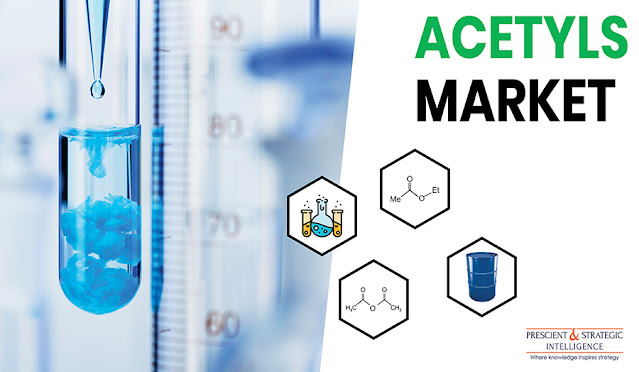
Organic compounds containing a methyl group joined with a carbonyl group by a single bond are known as acetyls. The acetyl group is primarily found in acetic acid, acetylsalicylic acid, acetylcysteine, acetylcholine, and acetaminophen. Acetylation refers to the chemical process of formulating the acetyl group into a molecule. The acetyl groups of acetic anhydride, vinyl acetate monomers, and acetic acid are used in the intermediates themselves used in the production of inks, adhesives, solvents, and water-based paints.

Large volumes of acetyls are being used in the production of purified terephthalic acid (PTA) and ester solvents, which require acetic acid in abundance. Thus, the surging use of acetic acid in the production of PTA and ester solvents will help the acetyls market progress at a CAGR of 6.9% during 2016–2022. According to P&S Intelligence, the market had a value of $22,004.7 million in 2015. Additionally, the burgeoning demand for adhesives from numerous industries will propel the consumption of vinyl acetate monomers globally.

Geographically, Asia-Pacific (APAC) consumed the highest volume of acetyls in the recent past, and it is also expected to adopt these compounds at the highest rate in the forthcoming years. This can be attributed to the flourishing electronics sector, expanding automotive manufacturing base, and increasing investments in the oil and gas sector in the region. Moreover, the surging healthcare expenditure, owing to the mounting per capita income and improving living standards of people, will augment the consumption of acetyls in the region.

Furthermore, the Rest of the World (RoW) acetyls market is expected to register a significant sale of these chemicals in the upcoming years. This will be due to the mounting investments being made in the automotive, pharmaceutical, and oil and gas industries in the region. Besides, the accelerating industrialization and urbanization rates will propel the consumption of the compounds in RoW. Acetyl requirements of end-use industries of APAC and RoW are met by Eastman Chemical Company, DuPont, The Dow Chemical Company, Jubilant Life Sciences, Wacker Chemie AG, BP PLC, Helm AG, and Celanese Corporation.

Thus, the burgeoning demand for acetic acid and increasing installation of PV cells will fuel the consumption of acetyls globally.


Why is Demand for Tungsten Carbide Exploding?

The growing adoption of tungsten carbide in various industries such as oil & gas, defense, metalworking, power generation, and automotive is fueling its sales across the world. Tungsten carbide exhibits high stiffness and thermal conductivity and provides good resistance against ethanol, gasoline, acetone, water, ammonia, organic solvents, and weak acids. It can be easily molded and pressed into various sizes and shapes for use in applications in cutting tools, equipment, industrial machinery, abrasives, and drills. 

Besides, the recovery in the oil and gas industry and increasing oil and gas exploration & production (E&P) activities and expansion of the metalworking industry are also propelling the demand for tungsten carbide across the world. Due to these factors, the global tungsten carbide market is exhibiting huge expansion, as a result of which, the revenue of the market is predicted to rise from $1,762.1 million in 2017 to $2,176.8 million by 2023, while the market will advance at a CAGR of 3.6% from 2018 to 2023 (forecast period).

Geographically, the tungsten carbide market will register the fastest growth in the Asia-Pacific (APAC) region in the coming years, as per the estimates of the market research company, P&S Intelligence. This will be because of the growing requirement for tungsten carbide powder in the automotive industry. For example, China witnessed the largest manufacturing of commercial vehicles and passenger cars in the world in 2017. The manufacturing of motor vehicles grew in the country from 28.1 million in 2016 to 29.0 million in 2017. 

Hence, it is safe to say that the demand for tungsten carbide will rise enormously in the coming years, primarily because of the growing usage of the material in the automotive, construction, and oil & gas industries, which are themselves exhibiting huge expansion all over the world.