IoT in Manufacturing Market to Reach $194.9 Billion by 2030, Driven by AI Integration and Industrial Automation

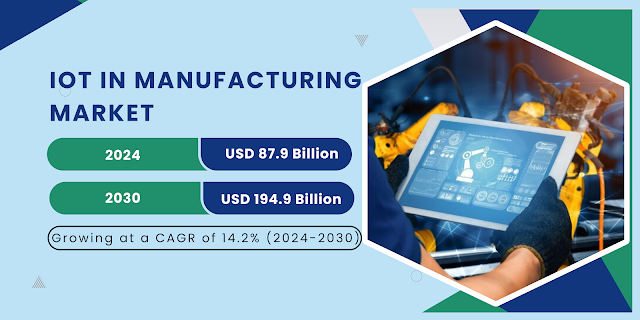
According to the latest market research study published by P&S Intelligence, the global internet of things in manufacturing market is projected to grow significantly, reaching a value of $194.9 billion by 2030, with a compound annual growth rate (CAGR) of 14.2%, up from $87.9 billion in 2024. This rapid expansion reflects a transformative shift within the manufacturing sector, driven by advancements in industrial automation, artificial intelligence (AI), and enhanced connectivity across production systems.

Download free Report Sample Now

Market Overview:

The IoT in manufacturing market has emerged as a key catalyst for operational efficiency, data-driven decision-making, and enhanced product quality. By integrating smart sensors, devices, and cloud-based technologies, manufacturers are increasingly able to collect real-time data from machines, production lines, and the supply chain. This data is then used to optimize processes, reduce downtime, improve safety, and enhance product quality across the manufacturing lifecycle. The ongoing trend of automation is further accelerating the adoption of IoT technologies in production facilities worldwide.

Key Factors Driving Growth:

  • Industrial Automation: The primary driver for the market is the growing adoption of industrial automation. As manufacturers strive to improve efficiency and reduce operational costs, the implementation of IoT technologies has become integral. IoT enables automation systems to communicate and make real-time adjustments based on collected data, significantly reducing human intervention and increasing production speeds.
  • Artificial Intelligence (AI) Integration: AI and IoT are complementing each other, creating highly intelligent manufacturing environments. AI-enabled IoT devices are capable of processing vast amounts of data generated by sensors in real-time. This allows manufacturers to gain valuable insights into operational performance, predict potential failures, and make smarter decisions based on predictive analytics. For instance, AI-driven algorithms help forecast maintenance needs, ensuring machines are serviced before breakdowns occur, minimizing downtime.
  • Enhanced Supply Chain and Inventory Management: IoT applications in manufacturing are also revolutionizing supply chain and inventory management. By integrating IoT sensors throughout the production chain, manufacturers can track inventory levels, monitor equipment, and even automate reordering processes. This leads to greater accuracy, faster delivery times, and a more streamlined operation, all while reducing stockouts and overstocking issues.
  • Workplace Safety and Security: Another critical benefit of IoT in manufacturing is its ability to enhance workplace safety. IoT-enabled devices can monitor environmental factors such as temperature, humidity, and gas levels in real-time. In case of any anomalies, alerts are triggered, helping to prevent accidents or safety violations. Furthermore, IoT allows for remote monitoring of machines and processes, ensuring adherence to safety standards while improving security protocols.

Regional Insights:

  • North America: The North American market is currently the largest revenue-generating region, driven by the early adoption of cutting-edge technologies, strong industry presence, and substantial investments in smart manufacturing. The United States is home to a robust manufacturing sector that is heavily investing in IoT systems to drive productivity, especially in automotive, aerospace, and electronics industries.
  • Asia-Pacific (APAC): The Asia-Pacific region is expected to witness the fastest growth during the forecast period. Rapid industrialization, particularly in countries like China, India, and Japan, along with government initiatives promoting smart factory adoption, is creating a conducive environment for IoT technologies in manufacturing. The region’s shift towards smart manufacturing is driven by the need to reduce labor costs and enhance operational efficiency in an increasingly competitive market.
  • Europe: Europe is also experiencing significant growth in the IoT in manufacturing market, particularly in countries like Germany and the U.K., where industrial automation and IoT integration have already made substantial inroads. The region’s emphasis on Industry 4.0 and the digitalization of its manufacturing sector is expected to further drive demand for IoT technologies in the coming years.

Challenges and Barriers:

Despite the significant opportunities, the IoT in manufacturing market faces challenges such as high initial implementation costs, security concerns, and interoperability issues. The complexity of integrating IoT solutions into existing legacy systems is another hurdle for many manufacturers. Additionally, concerns regarding data privacy and the potential vulnerabilities of connected devices in manufacturing plants are creating obstacles to broader adoption.

Key Players in the Market:

Several global players are significantly impacting the growth of the IoT in manufacturing market. Some of the prominent companies providing IoT solutions for the manufacturing industry include Siemens AG, IBM Corporation, Cisco Systems, Inc., Honeywell International, Inc., GE Digital, and PTC Inc. These companies are investing heavily in developing advanced IoT technologies, AI integrations, and cloud-based platforms to address the increasing demand for smart manufacturing solutions.

Global GIS in Telecom Industry Surges with 13.2% CAGR Amid Growing 5G Demand

According to the latest market research study published by P&S Intelligence, the global GIS in telecom market is poised for substantial growth, with its valuation projected to escalate from USD 2,164.8 million in 2024 to USD 4,516.6 million by 2030, registering a robust CAGR of 13.2% during the forecast period. This surge is primarily attributed to the rapid expansion of the telecom industry worldwide, driven by increasing internet penetration and the advent of advanced communication technologies such as 5G.

GIS plays a pivotal role in capital planning decisions within the telecom sector, aiding companies in effective capacity planning by providing detailed data on existing infrastructure and network performance. The deployment of 5G networks necessitates precise location analysis for network installations, a requirement efficiently addressed by GIS solutions. With governments worldwide investing heavily in 5G technology, the demand for GIS solutions in the telecom sector is anticipated to escalate. GIS's ability to offer detailed spatial analysis makes it indispensable for telecom companies aiming to enhance network connectivity and expand their reach.

Download free Report Sample Now

Key Insights

Market Segmentation:

·         By Offering: The market is segmented into hardware, software, data, and services, catering to various needs within the telecom sector.

·         By Deployment Type: GIS solutions are deployed either on-premises or via the cloud, providing flexibility and scalability to telecom companies.

·         By End User: The end-user segment includes SMEs and large enterprises, with large enterprises currently holding the dominant share due to their extensive use of GIS for network planning and expansion.

Regional Trends:

·         North America: Currently the largest market, driven by advanced telecom infrastructure and early adoption of GIS technologies.

·         Asia-Pacific: Projected to be the fastest-growing region, attributed to rapid urbanization, increasing internet users, and significant investments in 5G infrastructure.

Technological Advancements:

·         The integration of AI and IoT with GIS is revolutionizing the telecom sector. Miniaturized GIS systems embedded in sensors and connected devices enable real-time data collection, enhancing network planning and decision-making processes.

·         These advancements facilitate more flexible and accurate geospatial data collection, crucial for the deployment and maintenance of telecom networks.

Competitive Dynamics:

·         The market is fragmented, with numerous players offering specialized GIS solutions tailored to telecom needs.

·         Companies are focusing on integrating advanced technologies into their GIS offerings to stay competitive and meet the evolving demands of the telecom industry.

Emerging Opportunities:

·         The ongoing expansion of 5G networks presents significant opportunities for GIS solution providers.

·         As telecom companies strive to enhance network coverage and performance, the demand for sophisticated GIS tools for precise planning and analysis is expected to rise.

In summary, the GIS in telecom market is experiencing robust growth, driven by technological advancements and the expanding needs of the telecom industry. The integration of GIS with emerging technologies like AI and IoT is set to further enhance its value proposition, making it an indispensable tool for telecom companies worldwide.

Robotic Process Automation Market Booms, Forecast to Hit USD 68.2 Billion by 2032

According to the latest market research study published by P&S Intelligence, the global robotic process automation (RPA) market is poised for significant growth, with projections indicating an increase from $5.1 billion in 2024 to $68.2 billion by 2032, reflecting a robust compound annual growth rate (CAGR) of 39.3% during the forecast period from 2025 to 2032.

Download free Report Sample Now

Market Dynamics and Growth Drivers

The surge in RPA adoption is attributed to several key factors:​

  • Enhanced Operational Efficiency: RPA enables organizations to automate repetitive tasks, leading to significant improvements in process efficiency and accuracy.​
  • Cost Reduction: By minimizing the need for manual intervention, RPA helps in reducing operational costs associated with human labor.​
  • Improved Customer Experience: Automated processes ensure faster response times and consistent service delivery, enhancing overall customer satisfaction.​
  • Integration with Advanced Technologies: The incorporation of artificial intelligence (AI) and machine learning with RPA is expanding its capabilities, allowing for more complex and intelligent automation solutions.​

Regional Insights

  • North America: Currently holds the largest market share, driven by early adoption and technological advancements.​
  • Asia-Pacific (APAC): Expected to be the fastest-growing region, fueled by increasing digital transformation initiatives and the growing demand for automation solutions in emerging economies.​

Strategic Developments

Key players in the RPA market are focusing on strategic partnerships and collaborations to enhance their service offerings and expand their market presence. These alliances between software vendors, service providers, and cloud service providers are instrumental in driving the adoption of RPA across various industries.