Global AI in Manufacturing Industry Set for 36% CAGR Amid Rise of Intelligent Automation

The global artificial intelligence in manufacturing market, valued at approximately USD 12.4 billion in 2025 and estimated to reach around USD 18.6 billion in 2026, is projected to surge to nearly USD 295.8 billion by 2035, registering an impressive CAGR of about 36% during the forecast period from 2026 to 2035. This exceptional growth trajectory reflects the rapid transformation of manufacturing ecosystems toward intelligent, data-driven operations.

Download free Report Sample Now

The market expansion is primarily driven by the accelerating adoption of predictive maintenance, real-time analytics, and AI-powered supply chain optimization across both developed and emerging industrial economies. Manufacturers are increasingly integrating AI technologies to enhance operational efficiency, improve product quality, and significantly reduce production downtime, creating a strong foundation for long-term industry growth.

Government-backed initiatives such as the U.S. National Institute of Standards and Technology (NIST) AI Manufacturing Program, the European Union’s Horizon Europe framework, and India’s National AI Mission are playing a pivotal role in advancing AI deployment. These programs are fostering innovation, enabling workforce development, and establishing standardized protocols that support the widespread implementation of AI-enabled robotics, computer vision systems, and smart factory solutions.

A key trend shaping the market is the shift toward intelligent automation and Industry 4.0-driven manufacturing environments. Companies are increasingly adopting machine learning algorithms, digital twins, and advanced analytics platforms to enable real-time monitoring, predictive insights, and autonomous decision-making. This evolution is redefining production processes, enhancing flexibility, and strengthening global competitiveness.

The growing emphasis on smart factory infrastructure and digital transformation is further accelerating market growth. Investments in automation equipment, AI-integrated production lines, and cloud-enabled industrial platforms are enabling manufacturers to optimize resource utilization, forecast demand more accurately, and respond effectively to supply chain disruptions.

However, despite strong growth prospects, the market faces challenges such as high initial investment costs and the complexity of integrating AI technologies into existing manufacturing systems. Small and medium-sized enterprises, particularly in developing regions, may encounter financial and technical barriers that could slow adoption rates. Additionally, increasing reliance on advanced AI infrastructure and the need for robust cybersecurity frameworks add to operational complexities.

Nevertheless, significant opportunities continue to emerge, particularly in predictive maintenance, AI-driven supply chain management, and energy optimization solutions. The rise of public-private partnerships, innovation hubs, and industrial AI research programs is expected to further accelerate adoption across sectors such as automotive, aerospace, electronics, and heavy machinery.

Regionally, Asia Pacific leads the market due to rapid industrialization and strong government support for digital transformation, followed by North America and Europe, where advanced infrastructure and early technology adoption continue to drive demand.

The competitive landscape remains dynamic, with major players such as Siemens AG, IBM Corporation, ABB Ltd., Rockwell Automation, NVIDIA Corporation, General Electric, Mitsubishi Electric, Fanuc Corporation, Intel Corporation, and SAP SE focusing on innovation, scalability, and strategic collaborations to strengthen their market position.

With AI becoming a core component of modern manufacturing, the industry is entering a new era of intelligent automation, where data-driven decision-making, operational efficiency, and sustainability will define future success.

IoT in Manufacturing Market to Reach $194.9 Billion by 2030, Driven by AI Integration and Industrial Automation

According to the latest market research study published by P&S Intelligence, the global internet of things in manufacturing market is projected to grow significantly, reaching a value of $194.9 billion by 2030, with a compound annual growth rate (CAGR) of 14.2%, up from $87.9 billion in 2024. This rapid expansion reflects a transformative shift within the manufacturing sector, driven by advancements in industrial automation, artificial intelligence (AI), and enhanced connectivity across production systems.

Download free Report Sample Now

Market Overview:

The IoT in manufacturing market has emerged as a key catalyst for operational efficiency, data-driven decision-making, and enhanced product quality. By integrating smart sensors, devices, and cloud-based technologies, manufacturers are increasingly able to collect real-time data from machines, production lines, and the supply chain. This data is then used to optimize processes, reduce downtime, improve safety, and enhance product quality across the manufacturing lifecycle. The ongoing trend of automation is further accelerating the adoption of IoT technologies in production facilities worldwide.

Key Factors Driving Growth:

  • Industrial Automation: The primary driver for the market is the growing adoption of industrial automation. As manufacturers strive to improve efficiency and reduce operational costs, the implementation of IoT technologies has become integral. IoT enables automation systems to communicate and make real-time adjustments based on collected data, significantly reducing human intervention and increasing production speeds.
  • Artificial Intelligence (AI) Integration: AI and IoT are complementing each other, creating highly intelligent manufacturing environments. AI-enabled IoT devices are capable of processing vast amounts of data generated by sensors in real-time. This allows manufacturers to gain valuable insights into operational performance, predict potential failures, and make smarter decisions based on predictive analytics. For instance, AI-driven algorithms help forecast maintenance needs, ensuring machines are serviced before breakdowns occur, minimizing downtime.
  • Enhanced Supply Chain and Inventory Management: IoT applications in manufacturing are also revolutionizing supply chain and inventory management. By integrating IoT sensors throughout the production chain, manufacturers can track inventory levels, monitor equipment, and even automate reordering processes. This leads to greater accuracy, faster delivery times, and a more streamlined operation, all while reducing stockouts and overstocking issues.
  • Workplace Safety and Security: Another critical benefit of IoT in manufacturing is its ability to enhance workplace safety. IoT-enabled devices can monitor environmental factors such as temperature, humidity, and gas levels in real-time. In case of any anomalies, alerts are triggered, helping to prevent accidents or safety violations. Furthermore, IoT allows for remote monitoring of machines and processes, ensuring adherence to safety standards while improving security protocols.

Regional Insights:

  • North America: The North American market is currently the largest revenue-generating region, driven by the early adoption of cutting-edge technologies, strong industry presence, and substantial investments in smart manufacturing. The United States is home to a robust manufacturing sector that is heavily investing in IoT systems to drive productivity, especially in automotive, aerospace, and electronics industries.
  • Asia-Pacific (APAC): The Asia-Pacific region is expected to witness the fastest growth during the forecast period. Rapid industrialization, particularly in countries like China, India, and Japan, along with government initiatives promoting smart factory adoption, is creating a conducive environment for IoT technologies in manufacturing. The region’s shift towards smart manufacturing is driven by the need to reduce labor costs and enhance operational efficiency in an increasingly competitive market.
  • Europe: Europe is also experiencing significant growth in the IoT in manufacturing market, particularly in countries like Germany and the U.K., where industrial automation and IoT integration have already made substantial inroads. The region’s emphasis on Industry 4.0 and the digitalization of its manufacturing sector is expected to further drive demand for IoT technologies in the coming years.

Challenges and Barriers:

Despite the significant opportunities, the IoT in manufacturing market faces challenges such as high initial implementation costs, security concerns, and interoperability issues. The complexity of integrating IoT solutions into existing legacy systems is another hurdle for many manufacturers. Additionally, concerns regarding data privacy and the potential vulnerabilities of connected devices in manufacturing plants are creating obstacles to broader adoption.

Key Players in the Market:

Several global players are significantly impacting the growth of the IoT in manufacturing market. Some of the prominent companies providing IoT solutions for the manufacturing industry include Siemens AG, IBM Corporation, Cisco Systems, Inc., Honeywell International, Inc., GE Digital, and PTC Inc. These companies are investing heavily in developing advanced IoT technologies, AI integrations, and cloud-based platforms to address the increasing demand for smart manufacturing solutions.
Global Self-Service Technology Market Set for Rapid Growth

According to the latest market research study published by P&S Intelligence, the global self-service technology market is poised for robust growth, expected to expand from USD 41.6 billion in 2024 to USD 87.9 billion by 2032, reflecting a compound annual growth rate (CAGR) of 9.9%. This surge is attributed to the increasing demand for automated devices, such as ATMs, kiosks, and vending machines, as well as advancements in wireless connectivity and biometric security. The retail sector, which is the largest end user, continues to drive significant demand, supported by the growing trend towards self-checkout systems that streamline operations and enhance customer service.

Government initiatives promoting cashless payments and the rising adoption of self-service systems in sectors like banking and retail also contribute to the market's expansion. The Asia-Pacific region is expected to lead this growth, offering substantial opportunities for industry players as technological advancements and increased consumer demand in emerging markets fuel the uptake of self-service solutions.

Download free Report Sample Now

Key Insights

The ATM category holds the largest share of the self-service technology market, accounting for 60% in 2024, with a strong growth trajectory due to continued demand for cash withdrawal and banking services.

Vending machines are anticipated to grow at the highest CAGR, driven by increasing adoption in corporate offices and commercial spaces, where efficiency and cost reduction are prioritized.

The retail sector is the largest end-user category and will experience the highest growth rate (10.5% CAGR), as self-service technologies like kiosks and checkout systems enhance customer experiences and operational efficiency in stores.

In the Asia-Pacific region, the market is set to grow rapidly, driven by a booming retail industry, a growing number of consumers using self-service machines, and expanding infrastructure for banking and hospitality.

Governments promoting digital payment solutions, such as cashless transactions, are influencing the shift towards self-service systems. This trend is particularly strong in countries like India, Italy, and the UAE, where digital adoption is on the rise.

The integration of biometric security features in ATMs and kiosks is enhancing transaction safety, promoting the continued expansion of these technologies, especially in financial services.

Despite growth prospects, market penetration remains slow in emerging economies due to technical illiteracy, data security concerns, and reluctance to replace traditional job roles, such as cashiers, with automated systems.

The need for stronger cybersecurity measures in self-service technologies, particularly in transaction-heavy environments, is increasing. This trend is pushing for the development of more secure systems but can also increase costs for manufacturers and end-users.

Companies are innovating to offer multifunctional self-service machines, enabling both cash and cashless transactions, which caters to diverse customer preferences and addresses varying regulatory requirements across different regions.

Retailers are increasingly adopting compact, cost-effective self-service solutions to improve operational efficiency, manage high customer volumes, and reduce wait times, driving adoption in various store types, including supermarkets and specialty shops.
Fraud Detection and Prevention Market to Hit $94.2 Billion by 2030: Key Drivers and Innovations

The digital era has brought unparalleled convenience and connectivity, but it has also opened the door to rising threats of fraud. As online transactions and digital services surge, the need for robust fraud detection and prevention systems has become a business imperative. Fraud not only disrupts financial operations but also erodes consumer trust and compliance with regulatory standards, making its mitigation a critical focus for organizations worldwide.

The global fraud detection and prevention market reflects this urgency, with revenues reaching USD 27.9 billion in 2023. Projected to grow at a CAGR of 19.0% from 2024 to 2030, the market is expected to hit USD 94.2 billion by the decade’s end. Several factors are fueling this growth, including advancements in technology, the increasing number of internet users, and the heightened need to protect industries such as banking and finance.

To learn more about this report: https://bitl.to/3fRP

Key Market Insights Driving Growth

The fraud detection and prevention market is experiencing significant expansion due to various factors:

Technological Innovation: Cutting-edge technologies like artificial intelligence (AI), machine learning (ML), and blockchain are reshaping fraud prevention strategies, enhancing the ability to detect and thwart malicious activities.

Evolving Threat Landscape: The rise in online transactions and cybercrime, particularly targeting older demographics, underscores the growing urgency for sophisticated fraud detection solutions.

Industry-Specific Demands: Sectors like banking and financial services are at the forefront of adopting fraud prevention technologies to safeguard customer data and maintain operational integrity.

The market also demonstrates a notable shift in its offerings, with services growing at a faster pace than software. Services, which include consulting and managed solutions, are anticipated to grow at a CAGR of 19.2% during the forecast period, driven by businesses seeking expert support to combat increasingly complex threats.

The Role of Technology in Fraud Prevention

Advanced technologies are the cornerstone of modern fraud detection and prevention efforts:

AI and Machine Learning: By analyzing vast datasets and recognizing patterns, these technologies can predict and prevent fraud in real time. They enhance the ability to respond to threats proactively and minimize potential damage.

Blockchain Technology: Blockchain adds an extra layer of security, with its decentralized and tamper-resistant design ensuring data integrity. Its use in fraud detection streamlines processes, reduces human error, and bolsters trust in digital transactions.

Real-Time Monitoring Systems: The integration of AI-powered systems with real-time analytics allows businesses to detect anomalies swiftly, minimizing the impact of fraudulent activities.

Regional Market Dynamics

The fraud detection and prevention market shows significant variation across regions:

North America: As a leader in adopting advanced technologies and adhering to stringent regulations, North America holds a prominent market share.

Asia-Pacific (APAC): APAC is poised for the fastest growth, driven by the rapid adoption of digital technologies and growing investments in fraud prevention solutions. In countries like India, the increasing digitization of financial services has spurred advancements in AI, ML, and biometrics, fostering growth in this sector.

Future Outlook and Trends

The fraud detection and prevention market is set for robust growth, with a focus on innovation and adaptability to emerging threats. Key drivers include:

  • The expanding use of machine learning and AI to predict and mitigate fraudulent activities.
  • The growing reliance on online applications and mobile banking, necessitating stronger security measures.
  • Increasing investments from governments and private enterprises in advanced fraud prevention technologies.

As industries continue to digitalize, the importance of staying ahead of fraudsters cannot be overstated. Companies that embrace advanced technologies and adapt to regional and global trends will be better positioned to protect their assets and maintain customer trust.

Conclusion

The rising tide of fraud poses significant challenges, but it also presents an opportunity to innovate and strengthen defenses. As the fraud detection and prevention market grows, organizations must prioritize investments in advanced technologies and stay informed about evolving threats. The future belongs to those who can adapt quickly and implement robust measures to safeguard their operations and customers. How prepared is your business to face the challenges of tomorrow?

North America Leads in Cloud Network Adoption and Innovation

According to a report from P&S Intelligence, the cloud-managed network market is projected to reach USD 50.3 billion by 2030, growing at a CAGR of 12.2% by the decade’s end. Cloud-managed networks provide organizations with scalability and flexibility, eliminating the need for physical hardware. By connecting to the network, companies can easily manage and safeguard their hardware and software.

Cloud Services Lead the Way

Infrastructure as a Service (IaaS) provides on-demand computing resources, allowing organizations to buy network assets online. Services like computer networks, subnetworks, and security systems can be easily managed via the cloud. Meanwhile, Software as a Service (SaaS) is the preferred model for availing cloud services due to its secure communication. SaaS offers internet-based services that ensure the security of applications through features like encryption, key management, security monitoring, identity management, and data privacy.

Rapid Growth of Public Cloud

Public cloud services are expected to expand the fastest, driven by their flexibility. This adaptability enables businesses to scale up operations in line with industry demands. Companies of all sizes, particularly larger enterprises, value the ability to adjust resources according to fluctuating workloads. Additionally, startups benefit from cloud services, which allow them to store data and focus on business growth without the hassle of hardware management.

North America Dominates Cloud Network Use

North America's IT sector is renowned for innovation in IoT and networking, fostering widespread adoption of cloud-managed networks. The region’s technological leadership has paved the way for advancements in service management. Many top companies in the region have embraced digitization, leveraging cloud network management solutions to stay competitive. Several nations in the region are heavily investing in tech advancements, with cloud services playing a vital role in this transformation by offering scalable and flexible solutions for network management.

Healthcare and Telecom Sectors Propel Data Center Server Market Expansion

In 2023, the global data center server market generated revenue of USD 139.1 billion and is expected to soar to USD 307.0 billion by 2030, growing at a compound annual growth rate (CAGR) of 11.6%. Several factors are driving this expansion, including the rise of the IT and telecommunications sector, the integration of AI and data analytics into servers, the increasing demand for cloud services, ongoing digitalization, and the surge of 5G technology, which requires higher data storage capacities.

Additionally, the growing trend of AI-powered server solutions and the escalating demand for organizational data storage are contributing to further market growth. Every day, companies handle massive amounts of data to improve products, enhance customer retention, and boost revenue. This requires efficient methods for managing such large quantities of data.

With billions of people connected to the internet, every online activity generates data. Businesses use this data for various purposes, such as managing inventory, monitoring human resources, and providing personalized product and service recommendations. Every day, 2.5 million gigabytes of data are generated, with a staggering 44 zettabytes of data currently in existence, 70% of which is created by users.


Key Insights:

  • The commercial sector is poised for substantial growth due to the increasing number of established businesses and startups.
  • AI, data analytics, IoT, and cloud computing are transforming corporate operations, further expanding the market.
  • Governments have implemented strict data management regulations, which, while costly for companies, are boosting the commercial sector's growth.
  • In 2023, the BFSI sector held a 45% revenue share, driven by the growing adoption of cloud solutions and the need for robust server infrastructure for data storage and processing.
  • The healthcare sector is expected to grow significantly due to advanced infrastructure, technical innovations, increased capital investments, and the rising importance of data storage, especially for telemedicine applications.
  • The IT and telecom sectors are set for major growth, driven by the rise of mobile internet users, increased software deployment, and a surge in startup initiatives, all of which are creating a greater demand for data storage and processing solutions.
  • Government sectors are experiencing significant growth due to data localization policies, cloud platform adoption, and the development of enterprise self-build data centers.
  • North America led the market with a 40% revenue share in 2023, and the region is expected to maintain its dominance due to its established IT infrastructure, industry giants, and high adoption of AI and machine learning technologies.
  • The U.S. will continue to lead, supported by its strong IT sector and the presence of numerous data centers.
  • The Asia-Pacific (APAC) region is forecast to grow at the fastest rate with a CAGR of 15%, driven by a rising number of internet users, digitalization, IT and telecom expansion, and increased cloud adoption.
  • Europe also had a significant revenue share, with growth driven by the adoption of digital technologies, increased internet usage, and 5G network rollouts, especially in the U.K., a key cloud industry hub.
  • The Middle East and Africa (MEA) will see notable growth due to globalization, digitalization, and rising investments in data centers, particularly in Africa.
Securing Tomorrow: Unveiling the Advantages of VSaaS for Modern Businesses

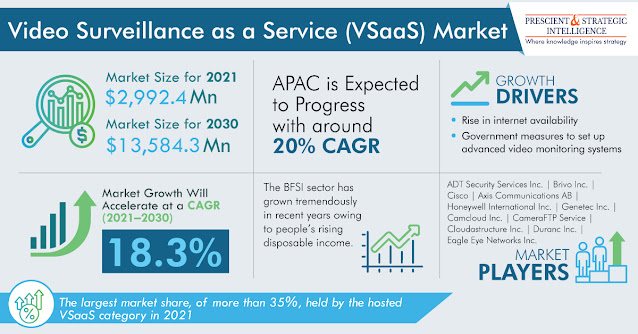
VSaaS is a cloud-based video surveillance system. This comprises of video recording, remote viewing, storage, management alerts, cyber security, and more. The service is fairly easy to install, needs little to no maintenance, and helps in securing the data to keep the business safe. VSaaS lets people to access recorded video from their laptop, tablet or smartphone.

Now, let us look at some of the reasons to, why the implementation of VSaaS is good for a business.

Video Surveillance as a Service Industry Growth and Forecast Report 2030

Economics of Scale

There are low upfront capital expenses, which means that there be more funds to invest in other areas of the business. Since several corporations often share server infra, the hardware is used and the price for supporting it reduces. Accompanied by this is low energy costs because of less servers running all through the day. The expenditures related to IT staff are decreased because of the fact that most work is not done in-house.

The Essential Fundamentals of the Cloud

The cloud lets on-demand self-service, which means a user can adjust abilities instantaneously without the need for contacting a service provider. All features can be accessed from laptops, tablets from anywhere relying on your settings and security parameters.

They are Flexible

When the video recordings are kept on the cloud, you access them irrespective of where they are watched. Depending on your provider and your cameras, there are numerous diverse options for the storage in the cloud along with on-premise hybrid solutions. VSaaS is customizable as per your requirements.

Scalability

If a company is growing in all facets, the surveillance doesn’t require to be interrupted. You can continuously add, take away, or move cameras depending on the existing requirements of the business. Pay for what you require, and only for what you want. You can choose the resolution and stowage that meets your present business model.

Security of the Highest Order

The main focus of surveillance is security. The need for applying video surveillance are many: stopping the destruction, breaking and entering, private data, public safety, high inventory warehouses. We can only keep the videos the from hacking and theft. All communication from cameras needs to be encoded from camera to the cloud. It is significant to be sure about this when you are looking to choose a provider for video surveillance.

What is to be Done in Case of Internet Connection Interruption?

It is often heard about internet matters disturbing cloud-based surveillance. Though, any trustworthy VSaaS provider provides “dual recording” in case of internet interruption, the camera will default to storage of the video on an SD card until it can reconnect with the internet. Whether there is recording all round the clock or only during specific hours, the cameras will not fail because of interruption.pf internet connectivity.

Summing Up the Scene

It is because of all these reasons that the demand for video surveillance as a service is growing and will reach a value of USD 13,584.3 million by the end of this decade.