Why Does Automobile Industry Require Lubricants?

The International Organization of Motor Vehicle Manufacturers (OICA) stated that, in 2020, 53,598,846 passenger cars and 24,372,388 commercial vehicles were sold across the world. The soaring adoption of automobiles can be majorly ascribed to the mounting per capita income of people in countries such as Brazil, India, Mexico, and China. Lubricants are utilized in the crankcase of the automotive engine to ensure the efficient operation of automobiles. The usage of these crude oil by-products also helps in increasing the lifespan of vehicles, as these products reduce the vehicle’s wear and tear.

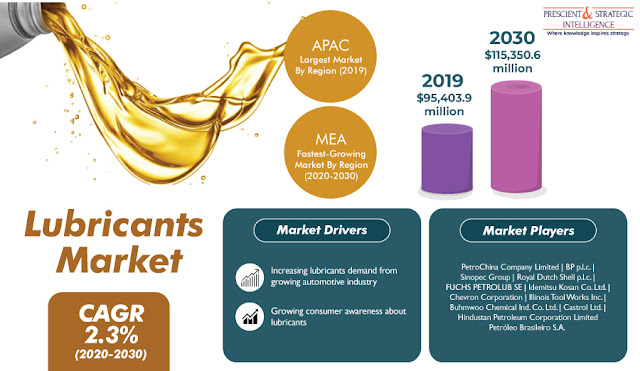
Thus, the increasing adoption of automobiles in developing nations and burgeoning consumer awareness about the benefits of these crude oil by-products will help the lubricants market advance at a CAGR of 2.3% during 2020–2030. According to P&S Intelligence, the market is expected to generate a revenue of $115,350.6 million by 2030. Lubricant producers across the world are adopting customer-oriented methods to generate brand awareness through visual and print media. Additionally, the provision of gifts and free samples by such production companies during promotional campaigns and trade shows also helps in imparting awareness regarding lubricants.

Geographically, Asia-Pacific (APAC) led the lubricants market in the recent past and it is expected to retain its dominance in the coming years as well. This is due to the rapid shift of manufacturing facilities to Asian nations from Western countries, owing to the availability of cost-effective labor and the existence of flexible environmental rules in the region. Moreover, the surging automobile production and sales will also augment the use of lubricants in the region. For instance, according to the Society of Indian Automobile Manufacturers (SIAM), India produced 22,652,108 vehicles and sold 18,615,588 automobiles during the financial year 2020–2021.

Whereas, the Middle East and African (MEA) region is expected to consume lubricants at the highest rate in the coming years, due to the existence of numerous oil wells in the region. Additionally, the flourishing manufacturing sector, owing to the mounting focus of MEA nations on diversifying their economies and reducing their economic reliance on oil, will also boost the adoption of lubricants in the region in the foreseeable future. Manufacturing facilities in MEA countries obtain lubricants at a low cost, due to the abundant availability of oil reserves in the region.

Thus, the burgeoning vehicle sales and growing consumer awareness about the benefits of lubricants will fuel the consumption of lubricants in the forthcoming years.

Usage of Lubricants Set to Rise Sharply in Mining and Quarry Applications in Future

Lubricants are viscous fluids that are used in several industrial applications for proper functioning of machines and their components. Just like any other industry, the mining sector requires machinery in abundance for its efficient functioning. This sector uses lubricants for quarry and mining applications. With the surging consumption of mineral oil lubricants and increasing mining activities in developing countries like China and India, the sales of lubricants are expected to boom in the coming years. At present, the mining sector is showing high preference for bio-based lubricants, on account of rising environmental concerns.

The increasing use of these lubricants in the coal mining industry and rising consumption of coal in the power sector in countries like Indonesia, China, and India will drive the lubricants market for mining and quarry applications at 5% CAGR during 2017–2023. The market size is expected to grow from $1,890.0 million in 2016 to $2,610.0 million by 2023. Moreover, the burgeoning demand for mineral and metal commodities and escalating consumption of natural resources like uranium, coal, and diamond will support the market growth in the coming years.

In recent years, there has been a considerable increase in research and development (R&D) activities in countries like China, Australia, India, and the U.S., which has resulted in numerous innovations and technological advancements in the mining and quarrying field. These developments have further led to the increased usage of lubricants for mining and quarrying applications. Moreover, the high gross domestic product (GDP) and robust economic growth in nations like India, Mexico, South Africa, Brazil, Kazakhstan, and Indonesia will boost the mining activities in these countries.

The mining and quarrying sector uses lubricants like mineral oil, bio-based, and synthetic. Among these, mineral oil lubricants are used most widely, due to their cost effectiveness. These lubricants are derived from crude oil; whereas, synthetic lubricants, such as polyalkylene glycols, polyalphaolefins, and ester oils, are developed by chemical reactions of substances under precise temperature and pressure. Furthermore, bio-based lubricants are derived from natural resources like mineral oils or plants. This type of lubricants ensures operational safety and improves the performance of machinery, as these are cleaners than the other two.

According to P&S Intelligence, the Asia-Pacific lubricants market for mining and quarry applications generated the largest revenue in 2016, globally. Moreover, the regional market is also expected to observe a rapid growth in the foreseeable future. This can be ascribed to the expansion of the coal mining sector in India and China, which would account for the largescale consumption of mining lubricants in the future. Additionally, the increasing implementation of government laws regarding mining lubricants will boost their adoption in the region. 

Thus, the expansion of the coal mining industry and the high-volume consumption of coal for power generation will amplify the usage of mining lubricants in the coming years.

Read More: https://www.psmarketresearch.com/market-analysis/lubricants-market-for-mining-and-quarry-applications