Why Does Automobile Industry Require Lubricants?

The International Organization of Motor Vehicle Manufacturers (OICA) stated that, in 2020, 53,598,846 passenger cars and 24,372,388 commercial vehicles were sold across the world. The soaring adoption of automobiles can be majorly ascribed to the mounting per capita income of people in countries such as Brazil, India, Mexico, and China. Lubricants are utilized in the crankcase of the automotive engine to ensure the efficient operation of automobiles. The usage of these crude oil by-products also helps in increasing the lifespan of vehicles, as these products reduce the vehicle’s wear and tear.

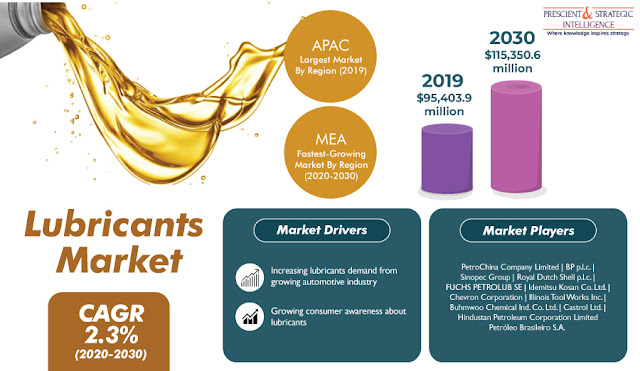
Thus, the increasing adoption of automobiles in developing nations and burgeoning consumer awareness about the benefits of these crude oil by-products will help the lubricants market advance at a CAGR of 2.3% during 2020–2030. According to P&S Intelligence, the market is expected to generate a revenue of $115,350.6 million by 2030. Lubricant producers across the world are adopting customer-oriented methods to generate brand awareness through visual and print media. Additionally, the provision of gifts and free samples by such production companies during promotional campaigns and trade shows also helps in imparting awareness regarding lubricants.

Geographically, Asia-Pacific (APAC) led the lubricants market in the recent past and it is expected to retain its dominance in the coming years as well. This is due to the rapid shift of manufacturing facilities to Asian nations from Western countries, owing to the availability of cost-effective labor and the existence of flexible environmental rules in the region. Moreover, the surging automobile production and sales will also augment the use of lubricants in the region. For instance, according to the Society of Indian Automobile Manufacturers (SIAM), India produced 22,652,108 vehicles and sold 18,615,588 automobiles during the financial year 2020–2021.

Whereas, the Middle East and African (MEA) region is expected to consume lubricants at the highest rate in the coming years, due to the existence of numerous oil wells in the region. Additionally, the flourishing manufacturing sector, owing to the mounting focus of MEA nations on diversifying their economies and reducing their economic reliance on oil, will also boost the adoption of lubricants in the region in the foreseeable future. Manufacturing facilities in MEA countries obtain lubricants at a low cost, due to the abundant availability of oil reserves in the region.

Thus, the burgeoning vehicle sales and growing consumer awareness about the benefits of lubricants will fuel the consumption of lubricants in the forthcoming years.

How Is Medical Sector Adding To Triazine Market Growth?

The rising application of triazine in the petrochemical, agrochemicals, and medical industries will accelerate the triazine market at a CAGR of 5.6% during the forecast period (2020–2030). According to P&S Intelligence, the market stood at $518.68 million in 2019 and it will reach $814.55 million in 2030. Currently, the market is witnessing a trend of mergers and acquisitions among the players. This market trend has supported the established and emerging players in increasing their profit share.

The increasing consumption of the compound in the petrochemical industry is a key growth driver for the triazine market. Triazine is used as a scavenger material to separate Hydrogen Sulfide (H2S) from crude oil, through the stripping process. The concentration of H2S is tracked in petroleum reservoirs as it is a flammable, corrosive, and life-threatening gas. As the exploration and operation of oilfields are done in adherence to the safety protocols, large quantities of triazine are used in these reservoirs.

The type segment of the triazine market is categorized into 1,2,3-triazine, 1,2,4-triazine, and 1,3,5-triazine. In 2019, the 1,3,5-triazine category held the largest market share, because this type is the most stable isomeric form of triazine and is consumed in high quantity in the chemical and oil and gas industries. This isomer is used in the production of triazine derivatives, such as melamine, monomethylamine (MMA), and monoethanolamine (MEA). In addition, 1,3,5-triazine is used in the production of pesticides and for scavenging operations in the oil and gas industry.

Geographically, North America dominated the triazine market in 2019, due to the booming production of shale gas and oil in the region. According to the Energy Information Administration (EIA), in the last decade, shale production in the U.S. has increased twelvefold. Shale gas is an economic substitute to crude oil and it serves as a feedstock for the production of various chemicals. Besides, the soaring investments in the oil and gas sector in the U.S. will also augment the demand for the compound in the foreseeable future.

Thus, the rising usage of triazine in the medical, petrochemical, and agrochemical industries will supplement market growth in the forecast years.

Surging Popularity of Traditional Recipes Driving Charcoal Demand in Philippines

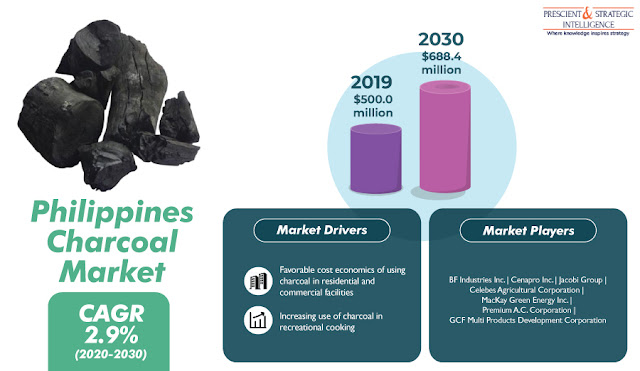
With the growing popularity of barbecued and grilled foods, the demand for charcoal is surging in Philippines. Moreover, the traditional favorability of the material among the people, on account of its lower cost than traditionally used fuels, huge popularity of charcoal-based cooking recipes, easy availability of feedstock (coconut shells and wood), affordability of accessories and stoves, and large-scale preference of people for foods cooked with the help of charcoal over other methods, is also propelling its sales in the country.

Additionally, charcoal is widely used in both upper-income and low-income households in the country, owing to its ability to preserve the natural flavor of foods, which further boosts its sales. Besides these factors, the extensive usage of the material for producing energy in both commercial and residential sectors is also driving the expansion of the Philippines charcoal market. As a result, the revenue of the market is predicted to rise from $500.0 million in 2019 to $688.2 million by 2030. Furthermore, the market will demonstrate a CAGR of 2.9% from 2020 to 2030 (forecast period).

The Philippines charcoal market is highly disorganization with the presence of a small number of domestic organizations, as per the observations of P&S Intelligence, a market research company based in India. These players are either small or medium scale enterprises and they have started including green charcoal in their product portfolios in recent years for effectively navigating regulatory and environmental constraints. Premium A.C. Corporation, Celebes Agricultural Corporation, Cenapro Inc., BF Industries Inc., Jacobi Group, GCF Multi Products Development Corporation, and MacKay Green Energy Inc. are some of the major charcoal producing companies in Philippines. 

Hence, it can be said without any doubt that the demand for charcoal will soar in Philippines in the coming years, mainly because of the surging requirement for the material as a cooking fuel, on account of the huge popularity of traditional charcoal-based cooking recipes and barbecued foods in the country.

What are Factors Propelling Global Demand for Compressed Air Energy Storage (CAES) Systems?

Compressed air energy storage (CAES) is used for storing the generated energy so that it can be used later. The utility sector uses this method for releasing the energy produced during periods of low demand (off-peak) in the periods of higher demand or peak load periods. In the CAES facilities, ambient air or some other gas is compressed and then stored under high pressure in a container that is kept underground. When power is required, this air is heated and made to undergo expansion in a turbine, which in, turn, drives the generator for producing power.

Apart from the surging energy requirements in several countries, the increasing concerns being raised over the pollution caused due to the large-scale usage of fossil fuels for power generation is also fueling the rise in the adoption of compressed air energy storage systems across the world. For example, “the International Energy Association (IEA) estimated that, in order to keep global warming below 2 °C, the world is expected to require 266 GW of energy storage by 2030, up from 176.5 GW in 2017”. 

According to the findings of Bloomberg New Energy Finance, at the current rate of energy storage across the globe, the energy storage industry will reach its storage targets and expand rapidly to a cumulative capacity of 942 GW in 2040. Thus, with the rapid advancement of the energy storage industry and the increasing focus on energy storage, the global compressed air energy storage (CAES) market will exhibit substantial growth over the next few years.

Diabatic, isothermal, and adiabatic are the most commonly used types of compressed air energy storage systems throughout the world. Out of these variants, the usage of the diabatic compressed air energy storage system is currently being observed to be very high. This is because of its simple design and construction and lower operating price than the isothermal and adiabatic compressed air energy storage systems. Furthermore, the isothermal and adiabatic energy storage systems are still in the developing phase.

However, despite their many advantages, the diabatic energy storage systems are being gradually replaced by more energy-efficient storage systems in many countries. This is because of the lower efficiency of these systems than the other storage devices. The efficiency of the adiabatic energy storage systems is almost 20% greater than the diabatic systems. Furthermore, the diabatic storage plants need gas-firing for their operations which causes environmental pollution. As a result, these facilities are being rapidly closed down in several countries.

Thus, due to the growing demand for power in many developing and developed countries and the rising environmental concerns being raised over the usage of fossil fuels for power production, the demand for compressed air energy storage systems will increase rapidly throughout the world in the future years. 

Why is Demand for Facility Management Services Soaring in Kuwait?

With the increasing tourist footfall, the hospitality industry is booming in Kuwait. This is, in turn, augmenting the requirement for facility management services in the country. Additionally, the government is taking various initiatives for boosting the tourism industry such as encouraging huge investments from private companies, increasing the capacity of airports, developing new attractions, and launching international promotion campaigns, which are accelerating the expansion of the hospitality industry. As tourists need hotels, resorts, and guest houses and clean premises, their soaring population is driving the need for facility management services in the country. 

Furthermore, the government is making hefty investments in various projects, particularly those pertaining to oil and gas extraction activities and processing facilities, malls, and residential buildings, which are further pushing up the requirement for facility management services in Kuwait. For example, the burgeoning requirement for public housing is predicted to fuel large-scale residential construction in the country in the coming years. Moreover, many real estate developers in the country are launching several facility management affiliates, thereby propelling the demand for facility management services.

Owing to the aforementioned factors, the value of the Kuwait facility management market is expected to rise from $958.2 million in 2019 to $2,057.5 million by 2030, while the market is predicted to advance at a CAGR of 8.3% between 2020 and 2030 (forecast period). The industry is highly fragmented in nature and the major players are currently focusing on contract wins in order to augment their revenue and gain an edge over their rivals.

When the type of property services is taken into consideration, the Kuwait facility management market is divided into mechanical & electrical maintenance, heating, ventilation, and air conditioning (HVAC) maintenance, and others. Amongst these, the HVAC maintenance services category will register the fastest growth in the market in the forthcoming years, as per the estimates of the market research firm, P&S Intelligence. This will be because of the extreme weather conditions in the country that generate a huge requirement for the renovation and refurbishment of the existing systems in commercial and industrial buildings for enhancing their efficiency. 

Hence, the demand for facility management services will rise enormously in Kuwait in the coming years, mainly because of the expansion of the tourism sector and the rapid development of various commercial, residential, and industrial buildings in the country.

Growing Construction Sector Driving Facility Management Solutions Demand in GCC Nations

The construction industry in Gulf Cooperation Council (GCC) countries is observing significant growth due to the surging tourism activities and improving economic conditions. In recent years, GCC member nations have been allocating huge budgets to the construction sector, owing to which, the countries are adopting facility management solutions in abundance. The rising budgetary allocation to this sector can be attributed to the escalating focus of member nations on reducing their economic dependence on oil and gas revenue. 

Additionally, the flourishing travel and tourism industry is also expected to drive the GCC facility management market at a CAGR of 10.1% during the forecast period (2020–2030). The market was valued at $53,804.3 million in 2019 and it is projected to reach $137,297.8 million revenue by 2030. The growth of the travel and tourism sector is supported by the vision of the governments to divert their attention from the oil and gas industry to other industries. Moreover, the introduction of the new visa system of Saudi Arabia will attract over 100 million visitors to the country by 2030. 

According to P&S Intelligence, Saudi Arabia led the GCC facility management market in the recent past, owing to the flourishing tourism and infrastructure sectors in the country. Moreover, the surging investments being made by the government of Saudi Arabia in the construction and infrastructure sectors, primarily on account of their increasing focus on reducing the country’s economic reliance on the oil and gas industry, are fueling the installation of facility management systems in the nation. For instance, the launch of real estate initiatives such as the Red Sea Project by 2030 and Amaala by 2028 will fuel the installation of such systems in the country in the forthcoming years.

Therefore, the growing construction sector and expanding travel and tourism industry will augment the demand for  facility management services in the GCC in the coming years.

How Is Infrastructure Development Supporting Saudi Arabia Facility Management Market Growth?

Factors such as surging construction activities and flourishing tourism industry are expected to accelerate the Saudi Arabian facility management market at a CAGR of 11.1% during the forecast period (2021–2030). According to P&S Intelligence, the market was valued at $31,264.1 million in 2020 and it is projected to reach $87,216.0 million by 2030. The market growth is also supplemented by the increasing investments in infrastructure development. Moreover, the trends of energy monitoring, robot usage, and heating, ventilation, and air conditioning (HVAC) optimization are also supporting the market growth.

The bolstering infrastructure industry, primarily on account of rising number of ongoing and upcoming construction plans, will support the demand for facility management services in Saudi Arabia in the coming years. Also, increasing investments in the infrastructure sector and rising government support for infrastructure development will fuel the market growth. For instance, in January 2019, the government unveiled its plan to invest $426 billion by 2030 to develop infrastructure and end-use industries.

The Saudi Arabian facility management market is characterized by the presence of numerous players, who have entered into small contracts, in recent years, to offer services at mega-infrastructure units, such as Amaala, Qiddiya, and King Salman Park. Apart from this, the companies are also aiming at landing bigger contracts to gain a competitive edge in the market. For instance, in August 2020, APSG Group announced that it has successfully started the provision of maintenance, hospitality, and cleaning services at Alrajhi Bank’s more than 150 branches and 612 ATMs in the southern part of Saudi Arabia.

Thus, the booming tourism sector and the strengthening infrastructure industry will support the market growth in the coming years.